You know you’re undercharging. You want to raise your rates. But you’re terrified of losing your clients.
What if they all say no? What if you have to start over from scratch? What if you lose the steady income you finally built?
I get it. I put off raising my rates for 8 months because I was scared. I was charging $150 for projects that should’ve been $400, but I convinced myself: “At least I have clients. Better not risk it.”
Finally, I raised my rates. And you know what happened?
I lost ONE client. The worst one. Everyone else said yes or negotiated slightly. My income doubled in 5 months.
Your simple, immediate action plan for a rate increase. Start charging what you’re worth.
Here’s exactly how to raise your rates without burning everything down.
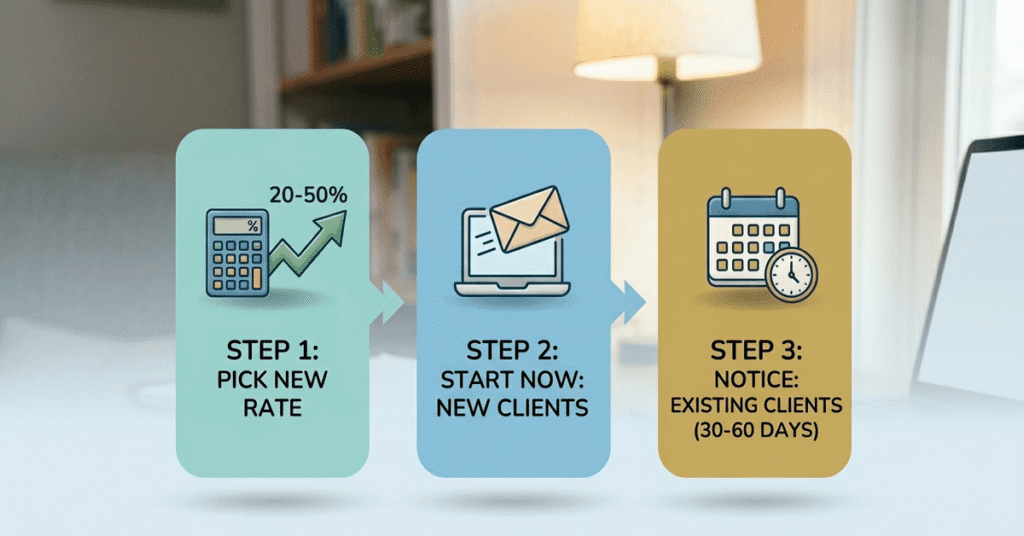
Quick Answer: The 3-Step Process
Step 1: Pick your new rate (20-50% increase) Step 2: Tell new clients the new rate (start immediately) Step 3: Tell existing clients with notice (30-60 days)
Success rate: 70-80% of clients will stay at your new rate.
Reality check: If your new rate is still 30% below market average, you’re probably still undercharging.
3. Build Confidence in Your New Number
Practice saying it out loud:
“My rate for homepage copy is $[X].”
If you stumble or feel embarrassed, you don’t believe in it yet. Keep practicing until it feels normal.
What helped me: I wrote my new rate on a sticky note and put it on my monitor. Saw it lots of times a day. Eventually it stopped feeling weird.
Strategy 1: Raise Rates for New Clients (Easiest)
Start here. This is the lowest-risk approach.
How It Works
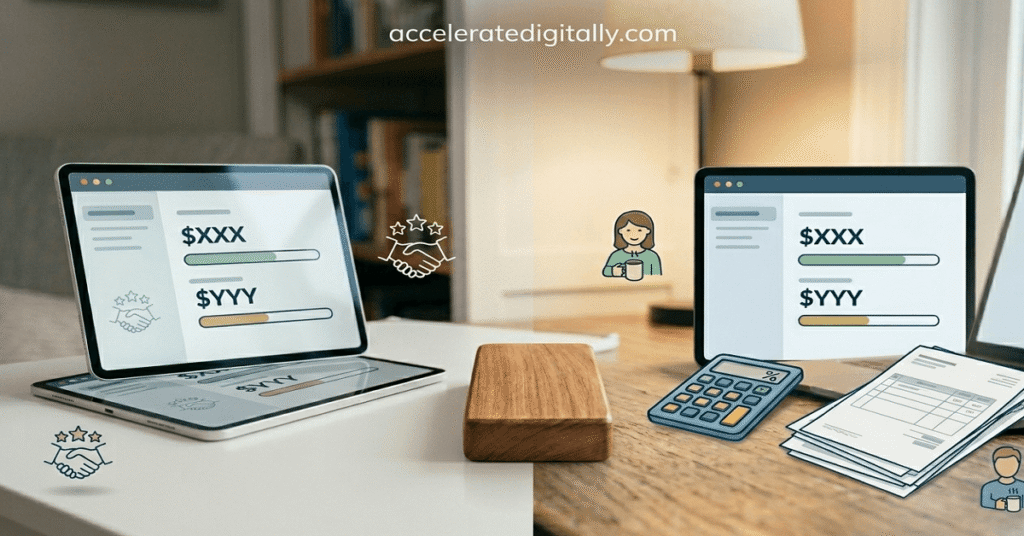
How a 'dual-rate structure' protects your current income while testing your new prices.
Today: You charge $200/project Tomorrow: New clients pay $300/project Existing clients: Still pay $200 (for now)
What to Say to New Clients
When they ask about pricing:
“My rate for [service] is $[new rate].”
That’s it. Don’t mention that it’s new. Don’t apologize. Just state it confidently.
What Usually Happens
Option 1: They say yes (70% of the time) Option 2: They negotiate slightly (20% of the time) Option 3: They say it’s too expensive (10% of the time)
If they say no, that’s fine. Those clients wouldn’t have been good fits anyway.
My Experience
First client at my new rate said: “Sounds good, when can you start?”
I expected pushback. Got none. Realized I should’ve raised rates 6 months earlier.
Strategy 2: Raise Rates for Existing Clients (Requires More Care)
This is trickier but totally doable.
Timing Matters
Good times to announce:
End of a project
Start of new quarter (January, April, July, October)
After you’ve delivered great results
When renewing a retainer
Bad times to announce:
Middle of a project
Right after they complained about something
During their busy season
The Email Script (Copy-Paste Ready)
Subject: Rate Update for [Your Service]

Hi [Client Name],

Quick update: I'm adjusting my rates starting [Date—give them 30-60 days notice].

My new rate for [Service] will be $[New Rate].

This won't affect any current projects—we'll complete [Current Project] at our original agreement. The new rate applies to future work after [Date].

I really value working with you and hope we can continue our partnership!

Let me know if you have any questions.

Best,
[Your Name]
Key Points in This Email
✅ Clear and direct (no apologizing) ✅ Gives advance notice (30-60 days) ✅ Honors current project pricing ✅ States when new rate applies ✅ Keeps it professional and brief
What NOT to Say
❌ “I’m sorry, but I have to raise my rates…” ❌ “Due to rising costs…” (they don’t care about your costs) ❌ “I hope you understand…” (sounds weak) ❌ “Let me know if this works for you…” (invites negotiation)
What Usually Happens
70% say: “Thanks for letting me know” (and keep working with you) 20% negotiate: “Can we do $[lower amount]?” (you decide if it’s worth it) 10% leave: Usually your worst clients anyway
My Real Example
I sent this email to 6 clients when raising from $200 to $300.
Results:
4 said “okay” and kept working with me
1 negotiated to $275 (I said yes)
1 said “too expensive” and left (they were difficult anyway)
Outcome: Made 40% more money with 5 clients instead of 6. Win.
Strategy 3: The Gradual Increase (For Nervous People)
If you’re really scared, do this:
Phase 1: New Clients Only (Months 1-3)
Charge new rate to new clients. Keep old clients at old rate.
Phase 2: Existing Clients on New Projects (Months 4-6)
When existing clients start a NEW project, quote new rate.
Email:
Hi [Client],

For this new project, my current rate is $[New Rate].

Happy to put together a proposal at that rate if you'd like to move forward!
Phase 3: Everyone at New Rate (Month 6+)
By now, everyone’s transitioned naturally.
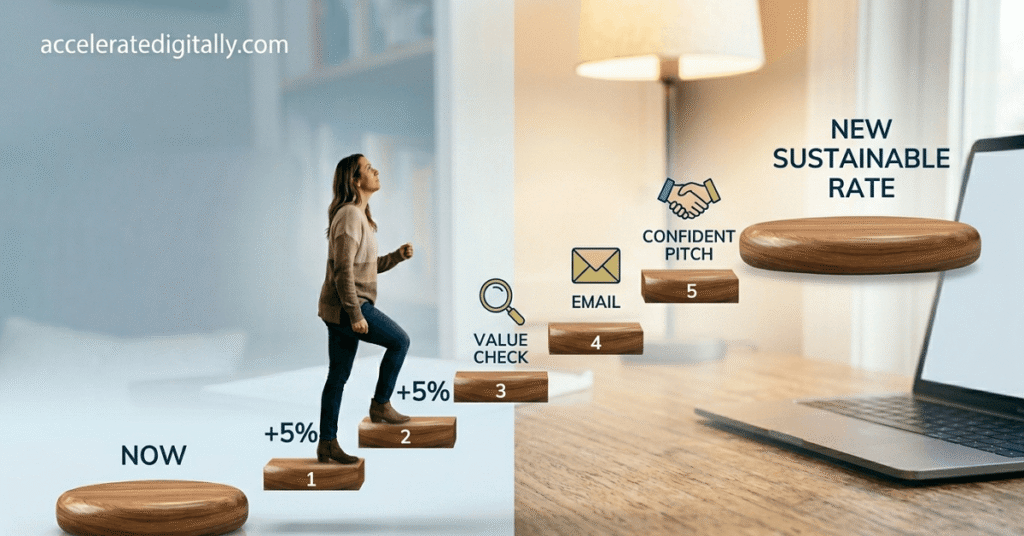
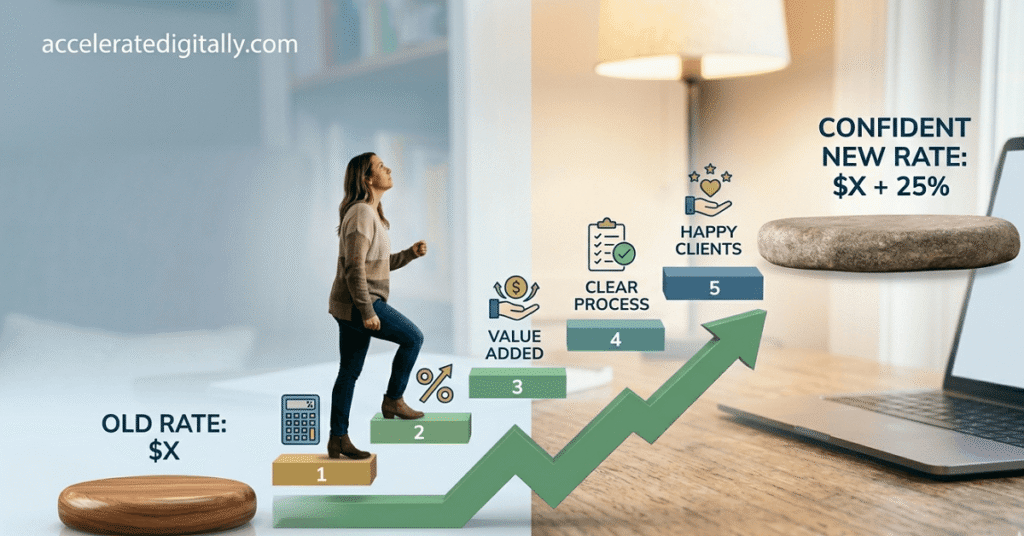
The step-by-step approach: Small, manageable adjustments create significant growth over time.
This method takes longer but feels safer.
What If Clients Actually Leave?
Let’s say you raise rates and lose 2-3 clients. Is that bad?
Do the math:
Before rate increase:
10 clients × $200/project = $2,000/month
Working 40 hours/week
After rate increase (lose 3 clients):
7 clients × $300/project = $2,100/month
Working 28 hours/week
Result: Same money, 12 fewer hours of work.
And guess what? You now have 12 hours to find BETTER clients at your new rate.
The clients who leave are usually:
The ones who don’t value your work anyway
The ones who ask for the most revisions
The ones who stress you out
Good riddance.
When to Raise Rates Again
Don’t raise once and stop. Make it a regular thing.
Recommended Schedule
Beginners (Year 1): Every 6 months, raise by 20-30%
Intermediate (Years 2-3): Every 6-12 months, raise by 15-25%
Experienced (Year 3+): Every 12 months, raise by 10-20%
Signs It's Time to Raise Again
✅ You’re booked solid and turning down work ✅ Clients say yes to your quotes immediately ✅ You haven’t raised rates in 6+ months ✅ Other copywriters charge more for the same work
And I still have 80% of my original clients (the good ones).
Key Takeaways: Raising Rates Successfully
✅ Start with new clients first – lowest risk, builds confidence ✅ Give existing clients 30-60 days notice – professional and fair ✅ Don’t apologize for raising rates-you’re running a business ✅ Use a clear, brief email- no long explanations needed ✅ Expect 70-80% to stay – losing 2-3 clients is normal and okay ✅ Raise rates every 6-12 months – make it a regular practice ✅ The clients who leave are usually the worst ones – addition by subtraction ✅ Your new rate attracts better clients – quality over quantity
Bottom line: Raising rates is scary but necessary. Most clients will stay. The income increase is worth it.
Use Our Free Pricing Calculator
Not sure what your new rate should be? Use Mille to calculate a fair rate based on: