Complete Guide to Copywriting Pricing for Beginners
Figuring out what to charge for your writing? Yeah, it’s tough.
If you charge too little, you’ll work yourself to death for almost no money. If you charge too much, you’re scared clients will run away. Most new copywriters charge way less than they should because they’re not sure what’s fair.
This guide is here to help. You’ll learn how to price your work based on your experience, how hard the project is, and what clients actually pay. By the end, you’ll know what to charge and feel good about it.
Why Pricing Feels So Confusing
The initial confusion of pricing often stems from a lack of industry benchmarks, but a systematic approach can provide clarity.
Let’s be real: when you’re just starting out, pricing feels like a total guessing game.
You search online and everyone says something different. One person says charge 5 cents per word. Another says $150 an hour. Someone else talks about “value-based pricing,” which sounds fancy but makes no sense when you’re new.
Here’s why it’s so confusing:
1. There’s No Fixed Price List
Plumbers charge set rates for fixing a sink. Copywriters? Not so much. The same blog post might be $50 from one writer and $500 from another. It depends on experience, how much research is needed, and what the client can afford.
2. Clients Don’t See All Your Work
They see the final document and think, “Why does this cost so much?” They don’t see you spending hours researching their industry, outlining, rewriting, and dealing with feedback.
3. You Don’t Feel Like an Expert Yet
When you’re new, you think, “Who am I to charge $300 for 1,000 words? I’m still figuring this out!” So you charge $50 instead and kick yourself later.
4. AI Makes You Doubt Yourself
Now clients ask, “Can’t I just use ChatGPT?” It’s tempting to drop your prices to compete with AI. Don’t. That’s a race you can’t win.
The good news? Once you understand how pricing works and what’s normal for beginners, it gets way easier
Four Ways to Charge for Your Writing
There are four main ways copywriters get paid. Let’s look at each one and figure out which makes sense for you.
1. Per-Word Pricing
How it works: You charge by th word. So if your rate is 20 cents per word and you write 1,000 words, that’s $200.
Good stuff:
Super easy to calculate
Clients get it right away
Standard for blog posts
Not so good:
Doesn’t count research time, revisions, or talking with clients
If you write fast, you don’t earn more per hour
Tempts you to write extra words just to make more money
Works best for: Blog posts and articles where you know the word count ahead of time.
What beginners charge: 10 to 25 cents per word (depends on how complicated the project is).
2. Per-Hour Pricing
How it works: You charge for each hour you work, like $30 an hour.
Good stuff:
You get paid for all your time
Works when the project isn’t clearly defined yet
Clients can see exactly what they’re paying for
Not so good:
You have to track every hour (annoying)
Fast writers make less money than slow writers
Clients might argue about how long things took
Works best for: Ongoing work, editing, or when you’re not sure how big the project is.
What beginners charge: $25 to $50 per hour.
3. Per-Project (Flat Fee) Pricing
How it works: One fixed price for the whole project. Like $500 for a homepage, no matter how long it takes.
Good stuff:
Covers research, strategy, revisions, and client emails
The faster you work, the more you earn per hour
Clients like knowing the total cost upfront
Not so good:
You need to guess how long it’ll take
Clients asking for “one more thing” can eat up your profit
Takes practice to estimate right
Works best for: Most writing projects – websites, sales pages, email series.
What beginners charge: Depends on the project (check the rate tables below).
Our recommendation: Per-project pricing is usually better for beginners because it covers everything you do, not just the writing part.
4. Value-Based Pricing
How it works: You charge based on how much money your writing makes for the client. If your sales page brings in $50,000, you might charge $2,500 to $5,000.
Good stuff:
You can make way more than hourly or per-word rates
When the client wins, you win
Clients will pay more when they see results
Not so good:
Hard to figure out the value, especially when you’re new
You need to really understand the client’s business
Doesn’t work for everything (like regular blog posts)
Works best for: Sales pages, landing pages, and marketing emails.
Real talk for beginners: This is advanced stuff. Start with per-project pricing and work up to this later when you can show results.
Figure Out Your Minimum Rate
Your baseline rate is the lowest you should charge to make this worthwhile. Here’s how to find yours:
Step 1: Pick Your Income Goal
Let’s say you want to make $40,000 a year from writing.
Step 2: Count Your Real Working Hours
You won’t spend 40 hours a week writing for clients. You’ll also spend time on:
Finding and pitching new clients (5-10 hours/week)
Admin stuff like invoices and emails (2-5 hours/week)
Learning and getting better at writing (2-3 hours/week)
Realistically, you’ll work for clients about 20-25 hours per week.
The math:
25 hours per week × 48 weeks a year (taking time off for vacations and sick days) = 1,200 hours
Step 3: Do the Division
$40,000 ÷ 1,200 hours = $33 per hour minimum
That’s your baseline. Charge less than this and you won’t hit your income goal.
Step 4: Adjust for Being New
When you’re just starting out, you’ll probably charge 60-80% of that number while you build your portfolio.
So: $33 × 0.7 = $23 per hour for beginners.
Step 5: Turn That Into Project Prices
Figure out how long each type of project takes, then multiply by your hourly rate.
Example:
A 1,000-word blog post takes about 4 hours (research, writing, editing, talking with the client)
4 hours × $23 = $92 minimum
Round up to keep it simple: $100-$125 for a beginner blog post.
Want this done for you? Use our free Mille calculator to figure out your rate based on your specific situation.
What Beginners Actually Charge (2026 Rates)
Here’s what new copywriters charge for different types of writing. These numbers are based on people with 0-3 years of experience.
Blog Posts & Articles
Word Count
Beginner Rate
Notes
500 words
$50-$125
Quick turnaround, light research
1,000 words
$100-$250
Standard blog post with SEO
1,500 words
$150-$375
In-depth article with research
2,000+ words
$200-$500
Long-form content, heavy research
Add 10-20% for SEO optimization (keyword research, meta descriptions, internal linking).
Website Copy
Service
Beginner Rate
Notes
Homepage
$200-$600
300-500 words + headlines
About page
$150-$400
400-600 words
Services page
$100-$300 per service
200-400 words each
Full website (5 pages)
$800-$2,000
Includes homepage, about, 3 service pages
Add 15-25% for industry research if you’re unfamiliar with the client’s niche.
Sales & Marketing Copy
Service
Beginner Rate
Notes
Email sequence (5 emails)
$250-$750
~300 words each
Sales page
$400-$1,200
800-1,500 words
Landing page
$300-$900
400-800 words
Product description (each)
$25-$75
100-200 words
Higher end of range applies if:
Client expects direct response results
Heavy research or technical knowledge required
Multiple revision rounds included
Social Media & Ads
Service
Beginner Rate
Notes
Social media posts (batch of 10)
$100-$300
Platform-specific
Ad copy (5 variations)
$150-$400
Headlines + body copy
Video script (1-2 min)
$100-$300
~250-400 words
Other Services
Service
Beginner Rate
Notes
Press release
$150-$400
~500 words
Case study
$300-$800
800-1,200 words
White paper
$500-$1,500
2,000-3,000 words
Newsletter (monthly)
$200-$600
3-5 sections
Note: These are beginner rates. As you gain experience and results, you’ll move into the intermediate range ($0.25-$0.50/word or 2-3x these project rates)
When You Should Charge More
Not every project is the same. Here’s when it’s totally fair to charge extra:
1. Lots of Research Needed
If a project needs hours of digging into information, add 15-30% to your price.
Like when:
You’re writing about technical stuff (software, finance, healthcare)
The topic needs a ton of data and facts
You have to interview multiple experts
When a project requires deep-dive research and competitive analysis, your pricing should reflect that extra strategic effort.
Example: A normal $300 blog post becomes $345-$390 with heavy research.
2. SEO Work
Basic SEO (using the right keywords) is normal. But if you’re doing full SEO – keyword research, checking competitors, optimizing everything – add 10-20%.
Example: A $400 homepage becomes $440-$480 with complete SEO.
3. Brand New Client
First-time clients need more help: extra calls, reading their brand guidelines, learning how they talk to customers. Charge 10-15% more for your first project with them.
Example: A $500 sales page becomes $550-$575 for a new client.
4. Rush Jobs
If they need it way faster than normal, charge a rush fee of 20-50%.
Like:
Need it in 2 days instead of 5? Add 25%
Need it tomorrow? Add 50%
Example: A $300 project becomes $375-$450 for rush delivery.
Don’t feel bad about rush fees. When you rush one project, doesn’t you have to turn down other work?
5. Lots of Revisions
Most projects include 1-2 rounds of changes. If they want “unlimited revisions” or more than 3 rounds, charge 15-25% more or put clear limits in your contract.
6. Learning Something New
Writing in a new format (like your first video script) or industry you don’t know yet? Add 10-20% for the time it takes to learn.
This is fair. You’re giving them the same quality, it just takes you longer to get there.
7. Difficult Clients
Some clients are great. Some aren’t. If you get a feeling the project will have:
Unclear directions
Tons of people giving feedback
Crazy tight deadlines
Add a 10-20% buffer or just say no to the project.
Quick tip: Our Mille calculator automatically adds these extras to your base price.
How to Tell Clients Your Price (Without Freaking Out)
Knowing what to charge is step one. Actually telling the client is step two. Here’s how to do it with confidence.
Before You Give a Quote
1. Don’t send a price too fast. Ask questions first:
What exactly do they need? (how many words, what pages, deadline)
What’s the goal? (more website visitors, more sales, build their brand)
Who are they trying to reach?
How many rounds of changes do they expect?
The more you know, the better your quote will be.
2. Give them a heads up. Tell them you’ll send a detailed proposal with pricing.
How to Write Your Quote
Option 1: Simple and Clear
Project: 5-page website (Homepage, About, 3 Service pages)

What you get:
- Homepage (500 words): $400
- About page (400 words): $300
- Service pages (300 words each × 3): $600
- SEO optimization: $200
- Total: $1,500

Timeline: 2 weeks (includes 2 rounds of changes)
Payment: Half upfront, half when done
Option 2: Give Them Choices
Option 1 - Basic: $1,200
- Website copy only (no SEO)
- 1 round of changes

Option 2 - Standard: $1,500 (I recommend this one)
- Website copy + SEO
- 2 rounds of changes

Option 3 - Premium: $1,900
- Website copy + advanced SEO
- 3 rounds of changes + strategy call
Clients like having choices. Most pick the middle option.
What to Actually Say
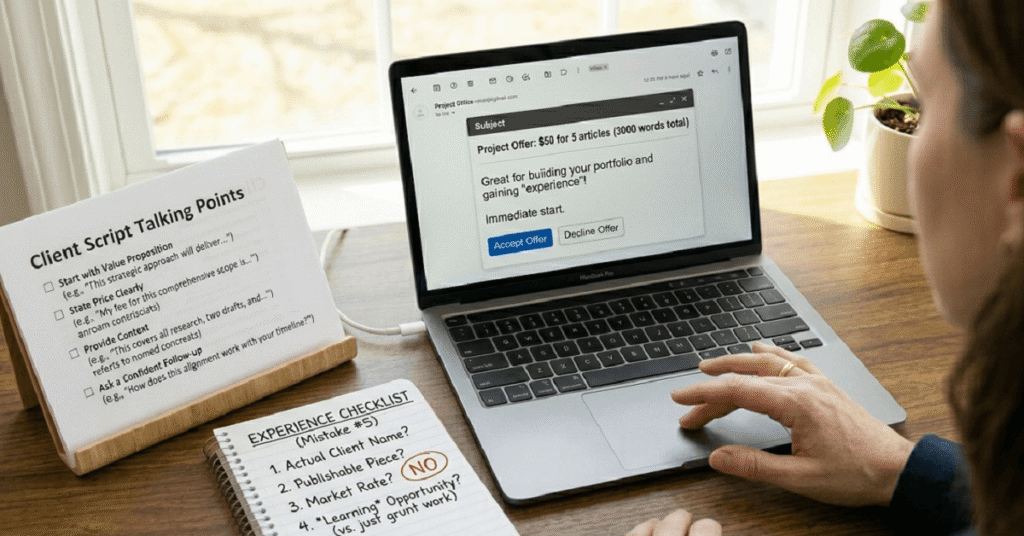
Using a pre-written script helps you deliver your rates with confidence and professionalism during client negotiations.
On a call:
“Based on what we talked about, the total is $1,500. That includes [list what they get], and everything will be done in two weeks. Does that work for you?”
In an email:
“Thanks for the details. Based on what you need [quick summary] the cost is $1,500. This includes two rounds of changes and a two-week turnaround. Let me know if you want to move forward and I’ll send you a simple contract.”
Important: Don’t say “I charge…” Say “the cost is…” or “the investment is…” Make it about what they’re getting, not what you’re taking.
When They Say "That's Too Expensive"
Try this:
“I get that budget matters. We could adjust what we do like start with just the homepage and about page, then add the other pages later. Would $800 for two pages work better?”
Don’t say:
“Okay, I can do it cheaper.”
“Sorry, I’m new so I’m flexible on price.”
“Oh, I didn’t know your budget was tight.”
You’re a professional. If they can’t afford you, that’s fine. Send them to another writer or politely pass on the project
Pricing Mistakes That Cost You Money
Mistake #1: Using Per-Word Pricing for Everything
Per-word works for blog posts. It doesn’t work for sales pages, websites, or anything that needs strategy and revisions.
Fix: Use per-project pricing for most things.
Mistake #2: Forgetting About Revisions
You quote $300, then they ask for four rounds of changes. Now you’re basically making $15 an hour.
Fix: Your price should include 1-2 rounds of changes. After that, charge extra. Put this in your contract.
Mistake #3: Charging Almost Nothing for "Experience"
Yeah, you need portfolio samples. But working for $25 an hour burns you out.
Fix: Charge fair beginner rates (60-80% of normal). If you really need samples, offer a portfolio discount like “I’m giving you 25% off in exchange for a testimonial and permission to use this in my portfolio.”
Be picky- only discount for clients who’ll give you great samples, not anyone who asks for a deal.
Mistake #4: Forgetting Taxes Exist
If you charge $1,000 for a project, you don’t keep all $1,000. You’ll pay 25-30% for taxes, software, and business costs.
Fix: Build taxes into your rates. If you need $40,000 after taxes, aim to make $52,000-$55,000 before taxes.
Mistake #5: Taking Cheap Work for "Experience"
Avoid the trap of "low-pay for experience"; instead, focus on building a portfolio that reflects your true market value.
Saying yes to $50 blog posts when you should charge $150 teaches clients to expect cheap work. And it attracts more cheap clients.
Fix: Turn down work that’s below your minimum. Scary at first, but it makes room for better clients.
Mistake #6: Never Raising Your Rates
You’ve been charging 15 cents per word for two years. You’re way better and faster now, but your prices haven’t changed.
Fix: Raise your rates every 6-12 months as you get more experience and results. Start with new clients, then tell existing clients 30-60 days before the increase.
FAQ: Common Questions About Copywriting Pricing
Q: How much should beginners charge per word?
A: Most beginners charge 10 to 25 cents per word. A simple blog post might be 10-15 cents per word ($100-$150 for 1,000 words). Something technical with lots of research could be 20-25 cents per word ($200-$250 for 1,000 words).
Q: Should I charge per word, per hour, or per project?
A:Per-project is best for most things (websites, sales pages, emails) because it covers research, revisions, and client calls – not just writing. Use per-word for blog posts and per-hour only when the project isn’t clearly defined yet.
Q: How do I figure out my rates?
A: Decide how much you want to make in a year, then divide by how many hours you’ll actually bill (usually 1,000-1,200 hours). That’s your hourly rate. Multiply that by how long a project takes. As a beginner, charge 60-80% of normal rates while you build your portfolio. Or use our free calculator to do the math for you.
Q: What if they say I'm too expensive?
A: First, explain what they’re getting (research, revisions, SEO, etc.). If they still can’t afford you, offer to do less – like fewer pages instead of cutting your rate. If they still say no, that’s okay. Pass on the project. Clients who can’t pay fair rates at the start are usually difficult later.
Q: Should I lower my prices to compete with AI?
A: Nope. AI can spit out words, but it can’t understand your client’s customers, match their brand voice, or think strategically. Don’t try to beat AI on price: you’ll lose. Instead, focus on what AI can’t do: real research, strategy, and human understanding. Clients who only care about cheap content aren’t your people anyway.
Q: How do I price rush projects?
A: Add 20-50% for rush work. Need it in 2 days instead of 5? Add 25-30%. Need it tomorrow? Add 50%. Rush fees are fair because you have to drop everything and say no to other work.
Q: Do I charge extra for revisions?
A: Yes. Your base price should include 1-2 rounds of changes. After that, charge extra. Like if you charge $300 with 2 rounds of changes included, charge $75-$100 for each extra round. Always put this in your contract so there’s no confusion.
Q: How do I raise my rates without scaring off clients?
A: Raise rates every 6-12 months and start with new clients first. For current clients, give them 30-60 days notice and explain it’s because you have more experience now and better results. Most clients get it. If someone can’t pay your new rate, that’s fine—it makes room for better work
Bottom Line: You Can Do This
Pricing doesn’t have to feel like guessing. Once you get how the different pricing methods work and what’s normal for beginners, you can quote prices without freaking out.
Remember these things:
✅ Use per-project pricing for most stuff (websites, sales pages, emails) ✅ Start at beginner rates (10-25 cents per word or 60-80% of normal rates) and raise them as you get better ✅ Charge more when it’s complicated: research, SEO, rush work, and difficult clients all deserve higher prices ✅ Don’t say sorry for your prices: you’re giving them value, not begging ✅ Know your minimum so you don’t work for peanuts
Most important: don’t charge too little because you’re scared. Clients respect fair prices when you explain what they’re getting.
Ready to figure out your price? Use our free Mille calculator to find out what to charge based on your experience, how hard the project is, and how much time you have. No signup, totally free.