What to Say When a Client Requests 'Unlimited Revisions'
“Can we do unlimited revisions?” My stomach always drops when I hear this. Because what they’re really asking is: “Can I keep changing things forever without paying more?” And the answer is no. But you can’t just say “no.” Here’s how to handle this request without losing the client or your sanity.
Why 'Unlimited Revisions' Is a Problem
Let me tell you what happened to me: Early client. Website homepage. They asked for unlimited revisions. I said yes because I didn’t want to seem difficult. Round 1: Changed the headline Round 2: Changed it back Round 3: New direction entirely Round 4: Back to round 1’s headline Round 5: Minor tweaks Round 6: More tweaks Round 7: Changed the whole tone After round 7, I’d spent 15 hours on revisions. For a $300 project. My hourly rate? $20. I learned: “Unlimited revisions” means unlimited work for the same price. Isn’t it?
What Clients Actually Mean
When they say “unlimited revisions,” they usually mean:
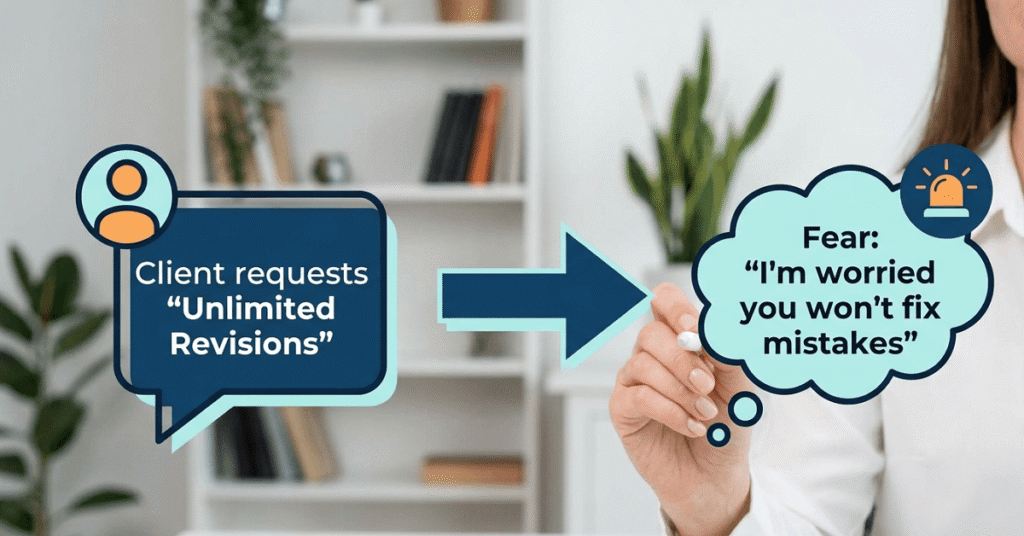
Option 1: “I’m worried you won’t fix mistakes”
They’re scared they’ll get bad work and be stuck with it.
Option 2: “I don’t know exactly what I want yet”
They’re still figuring it out and want flexibility.
Option 3: “I want you to work until I’m happy”
They have high standards (good!) but no clear definition of “done.”
Option 4: “Other freelancers offered this”
They’re comparing you to someone who included it.
Understanding what they mean helps you respond appropriately.
Translating 'Unlimited': Most generic revision requests are actually a plea for project security.
When they say “unlimited revisions,” they usually mean:
Option 1: “I’m worried you won’t fix mistakes”
They’re scared they’ll get bad work and be stuck with it.
Option 2: “I don’t know exactly what I want yet”
They’re still figuring it out and want flexibility.
Option 3: “I want you to work until I’m happy”
They have high standards (good!) but no clear definition of “done.”
Option 4: “Other freelancers offered this”
They’re comparing you to someone who included it.
Understanding what they mean helps you respond appropriately.
The Wrong Way to Respond
Don’t say: ❌ “No.” (Too blunt, sounds inflexible) ❌ “That’s not professional.” (Sounds judgmental) ❌ “Other clients don’t ask for this.” (Makes them feel difficult) ❌ “Fine.” (Then resent them for 7 rounds) These responses either lose the client or trap you in unlimited work.
The Right Way to Respond
Use this framework:
Acknowledge their concern
Explain your revision policy
Offer an alternative that protects both of you
Here’s the script I use:
The response framework: How to turn a difficult request into a professional boundary-setting moment.
The Full Response Script
“I totally understand wanting to make sure the copy is exactly right! Here’s how I handle revisions:
I include [2] rounds of revisions in the project price. This covers:
Tweaking headlines or CTAs
Adjusting tone or voice
Refining sections based on your feedback
What this means: You’ll get two opportunities to request changes. In my experience, that’s plenty for most projects; we usually nail it by round 2.
If we do need additional revisions beyond that (which is rare), they’re $[X] per round.
This structure works well because:
You’re not stuck with something you don’t love
We both know what to expect
It keeps the project moving forward
Does that work for you?”
Why this works: ✅ Acknowledges their concern (you understand they want it right) ✅ Sets clear boundaries (2 rounds included) ✅ Explains what’s covered (so they know what to expect) ✅ Shows it’s normal (other clients work this way) ✅ Provides escape hatch (additional rounds available at cost) ✅ Ends with question (gives them control)
Add Your Heading Text Here
Your proposal should specify:
What Counts as a Revision Round
One round = all feedback given at the same time. Example: Round 1 feedback:
Change headline
Adjust tone in section 2
Add bullet points to section 3
That’s ONE round. Not three separate rounds.
What Revisions Cover
Included in revision rounds:
Tweaking existing copy
Adjusting tone or voice
Refining structure
Incorporating feedback on what you already wrote
NOT included (these are scope changes):
Writing entirely new sections
Changing the target audience
Doubling the word count
Adding pages you didn’t agree to write
Red Flags to Watch For
When a client asks for unlimited revisions, ask yourself: 🚩 Do they know what they want? If they say “I’ll know it when I see it,” they don’t. Unlimited revisions = unlimited confusion. 🚩 Have they worked with freelancers before? First-time clients often don’t understand how revisions work. 🚩 Are they comparing multiple freelancers? “Other writers offered unlimited revisions” means they’re shopping based on terms, not quality. 🚩 Do they have unclear goals? “Just make it good” = recipe for endless revisions. If you spot 2+ red flags, consider whether this client is worth it.
The Biggest Lesson
“Unlimited revisions” sounds like good customer service. It’s not. It’s actually bad for both of you: Bad for you:
Endless work
Tank your hourly rate
Resent the client
Bad for them:
No clarity on “done”
Keeps tweaking instead of launching
Decision paralysis
Clear revision policies help clients make decisions and move forward. I believe you’re doing them a favor by setting limits.
✅ Unlimited revisions means unlimited unpaid work – always set limits ✅ Include 2-3 rounds in your standard proposal – covers 95% of projects ✅ Acknowledge their concern first – shows you understand ✅ Offer alternatives if they push back – more rounds for higher price ✅ Define what counts as a revision round – all feedback at once ✅ Distinguish revisions from scope changes – new sections = new quote ✅ Set timeline for revision requests – prevents requests 6 months later ✅ Clear limits help clients make decisions faster – you’re helping them
Bottom line: “Unlimited” anything in freelancing is a trap.
Set clear boundaries with professional alternatives.