

Simple Contract Template for Beginner Copywriters (With Fill-in-the-Blank Example)
You landed your first copywriting client. Amazing! But then they ask (or maybe you ask) “Do we need a contract?”
Yes. You absolutely do.
I know contracts sound scary. They sound like something only lawyers and big companies use. But here’s the truth: a simple contract is just a written agreement. It says what you’ll do, what they’ll pay, and when. That’s it.
A contract protects you and your client. It makes sure everyone is on the same page before work starts. And trust me, you’ll thank yourself later.
Why Beginner Copywriters Skip Contracts (And Why That's Risky)
When you’re just starting out, asking for a contract feels awkward. You don’t want to seem difficult. You want the client to like you. So you just… start working.
I get it. I’ve been there too.
But here’s what happens without a contract:
- The client asks for five rewrites when you only agreed to two
- They go quiet and never pay your invoice
- They say they want “one small change” that turns into rewriting the whole thing.
- You deliver the work, and they say it’s “not what they had in mind”
None of these are fun situations. A contract stops most of them before they happen.
What Should a Beginner Copywriter's Contract Include?
You don’t need a 10-page legal document. For most beginner projects, a simple one-page agreement covers everything that matters.
Here are the key pieces:
1. Your Name and the Client's Name
Sounds obvious, but you need to clearly state who is involved. Include your full name (or business name) and the client’s full name or company name.
2. Project Description
What exactly are you writing? Be specific. Instead of “website copy,” say “five pages of website copy including Home, About, Services, FAQ, and Contact.” The more detail here, the better.
Vague project descriptions are where scope creep hides. Scope creep is when the project slowly grows bigger without the pay growing with it.
3. Deliverables
What will you hand over at the end? List it out clearly. For example:
- One 800-word blog post
- Two rounds of revisions included
- Delivered as a Google Doc
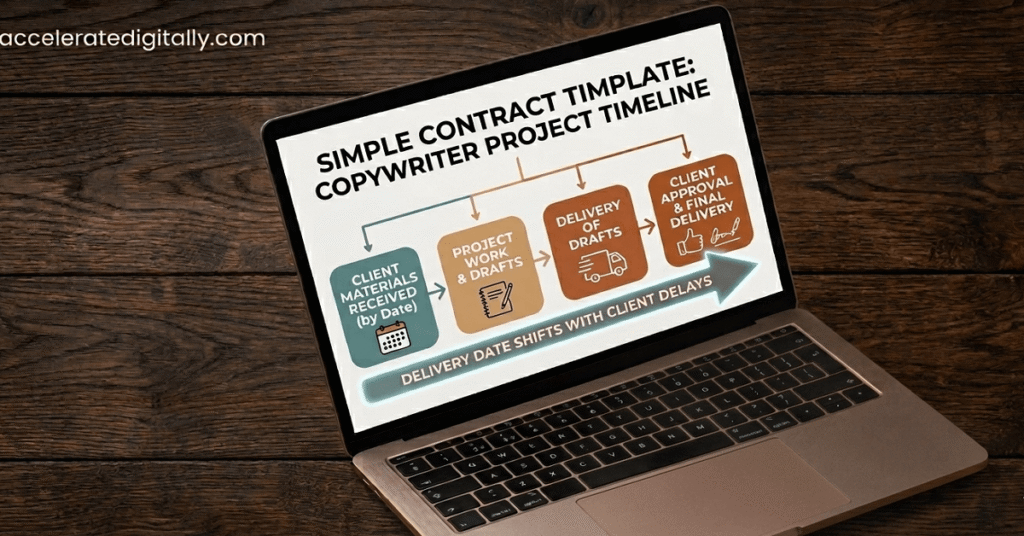
4. Timeline
When will you deliver the work? Give a specific date, not “soon” or “in a few weeks.” Also note what happens if the client is late giving you information you need (the deadline shifts accordingly.)
5. Payment Terms
This is the most important part. Include:
- Total fee – how much they’re paying you
- Deposit – I always recommend asking for 50% upfront, especially with new clients
- Final payment due date – typically on delivery or within 7 days of delivery
- Late payment – a small late fee (like 1.5% per month) encourages on-time payment
6. Revision Policy
How many rounds of revisions are included? What counts as a revision versus a whole new direction? Write it down. Something like “Two rounds of revisions included. Additional revisions billed at $X per hour” works perfectly.
7. Ownership and Rights
When does the client own the work? Typically, ownership transfers after full payment is received. Until then, you technically own what you wrote. State this clearly.
8. Cancellation Policy
What happens if the client cancels halfway through? A common approach is if they cancel after work has started, they pay for the work completed. The deposit is non-refundable.
9. Signatures
Both you and the client sign and date the contract. This makes it official. An e-signature tool like DocuSign or even a simple email confirmation can work for small projects when you’re starting out.
Simple Contract Template for Copywriters
Here’s a fill-in-the-blank contract you can use right away. Customize it to fit your project.
COPYWRITING SERVICE AGREEMENT
Date: [Date]
Copywriter: [Your Full Name or Business Name] Client: [Client’s Full Name or Business Name]
1. Project Description
The Copywriter agrees to provide the following services to the Client:
[Describe the project in detail like – “Three email sequences for a product launch campaign, each email between 250–400 words.”]
2. Deliverables
The Copywriter will deliver:
- [List each deliverable clearly]
- [Example: One sales page, approximately 1,000 words]
- [Example: Two rounds of revisions included]
All work will be delivered via [Google Docs / email / other format].
3. Timeline
First draft will be delivered by: [Date]
Note: This timeline assumes the Client provides all required information and materials by [date]. Delays from the Client’s side may shift the delivery date.
4. Payment
Total Project Fee: $[Amount]
- Deposit (50% due before work begins): $[Amount]
- Final Payment (due on delivery / within [X] days of delivery): $[Amount]
Accepted payment methods: [PayPal / bank transfer / other]
Late payments are subject to a [1.5%] monthly fee after [7] days past the due date.
5. Revisions
This agreement includes [n] rounds of revisions. A revision means refining the existing direction, not starting over with a new concept or angle.
Additional revisions beyond what is included will be billed at $[X] per hour.
6. Ownership and Rights
All work produced under this agreement remains the property of the Copywriter until full payment is received. Upon receipt of full payment, the Client receives full rights to use the content as they choose.
7. Cancellation
If the Client cancels this project after work has begun, the Copywriter will invoice for work completed to that point. The deposit is non-refundable.
If the Copywriter needs to cancel, they will notify the Client immediately and refund the deposit in full.
8. Confidentiality
The Copywriter agrees to keep all Client information, materials, and project details confidential and will not share them with third parties.
9. Limitation of Liability
The Copywriter is not responsible for the performance of the copy in terms of sales results, conversions, or business outcomes. Copywriting results depend on many factors outside the Copywriter’s control.
Signatures
By signing below, both parties agree to the terms of this agreement.
Copywriter Name: _ Signature: _ Date: _
Client Name: _ Signature: _ Date: _
How to Send This Contract
You don’t need to mail a physical copy. Here are easy ways to get it signed:
Free options:
- Type it up in Google Docs, share it with the client, and ask them to reply by email confirming they agree (keep that email — it counts as written agreement)
- Use DocuSign – they have a free plan for basic use
- Use HelloSign – also free for limited documents per month
Most clients are used to e-signatures. It’s fast and professional.
Common Questions Beginners Have About Contracts
“Is a simple contract actually legally binding?”
In most cases, yes. A written agreement signed by both parties is generally enforceable. That said, laws vary by location, so for large projects, it’s worth having a local legal professional review it.
“What if I’m working through a platform like Upwork?”
Platforms like Upwork have their own agreements in place. But for direct clients (anyone who finds you outside a platform) always use your own contract.
“Can I use this template for every project?”
Yes, with adjustments. Change the project description, deliverables, timeline, and payment for each new client. The structure stays the same.
One Last Thing
A contract isn’t about distrust. It’s about clarity. Good clients appreciate it because it protects them too. It shows you’re professional and you take your work seriously.
The first time you send a contract, it might feel formal. But after a couple of projects, it becomes second nature (just part of how you do business.)
Save this template somewhere easy to find. Customize it for your next project. And go get that signature before you write a single word.
Not sure what to charge before you send that contract? Use the free Mille pricing calculator to set a rate that’s fair for you and your client.
Related Articles
– How to Handle Scope Creep Without Conflict
– Complete Guide to Copywriting Pricing
– Free Pricing Calculator (Mille)
– Red Flags to Spot Before Taking a Copywriting Client