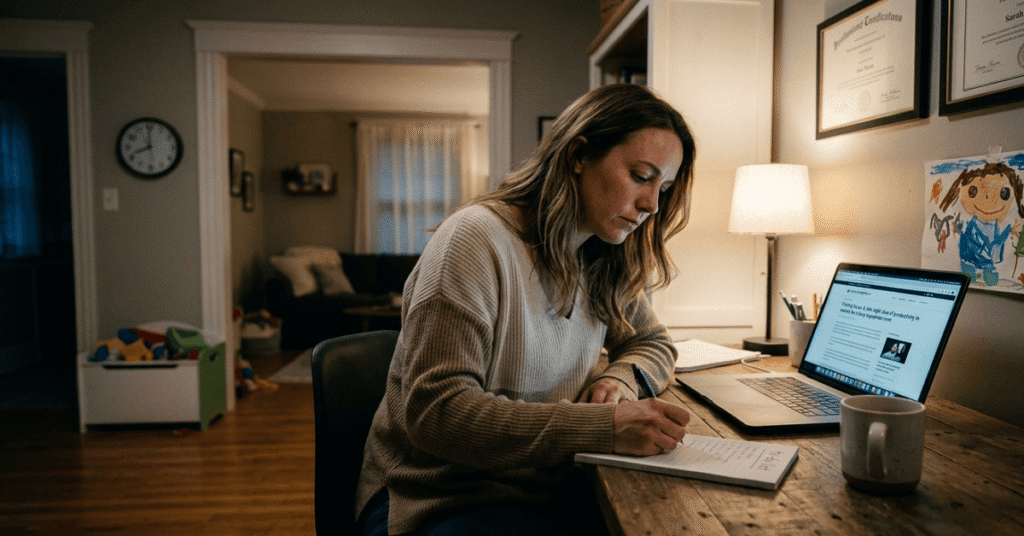
Forget “wake up at 4 AM” and “batch your tasks.” You know what’s actually productive when you have kids? Getting one thing done before someone needs a snack. Here are the productivity hacks that actually work when you’re writing between diaper changes, school pickups, and random meltdowns.
The Problem with Normal Productivity Advice
Standard productivity advice:
Block out 4 hours for deep work
Turn off all notifications
Work in a quiet space
Eliminate all distractions
Parent reality:
You have 47 minutes before pickup
Notifications include “your kid threw up at school”
Your “office” is the kitchen table
Your main distraction just walked in asking for the 4th snack today
We need different strategies.
Hack #1: The 2-Minute Rule (But Different)
Normal 2-minute rule: If something takes less than 2 minutes, do it now. Parent version: If something takes less than 2 minutes AND you’re already in work mode, do it now. Otherwise, add it to the list. Why this matters: I used to respond to every email immediately because “it only takes 2 minutes.” Problem: 10 emails = 20 minutes. My focused work time was gone.
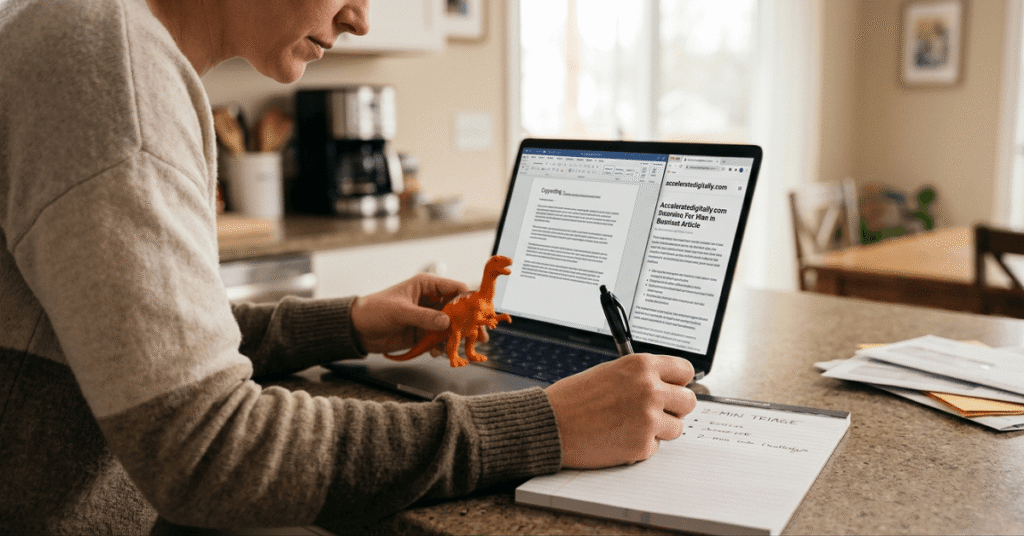
Juggling act: Immediate triage prevents small domestic distractions from derailing your copywriting workflow.
New rule:
Deep work time: Ignore emails, even quick ones
Admin time: Batch all the 2-minute tasks together
Result: Saved 30+ minutes daily by not constantly switching modes.
Hack #2: Start Mid-Project
Common advice: Start fresh projects when you’re focused. Parent hack: Start new projects in the middle, not the beginning. What this looks like: Instead of:
Brainstorm
Research
Outline
Write
Do this:
Use AI to brainstorm and outline
YOU write the actual copy
YOU edit and polish
Why this works: Starting from scratch takes mental energy. Starting with a rough draft (even an AI draft) is easier when you’re tired or interrupted. My process now:
Before bed: Ask Claude for outline and first draft
Morning: Edit and improve the draft
Takes 40% less time than writing from blank page
Hack #3: The Kitchen Timer Trick
What it is: Set a timer for exactly how long you have. How I use it: Kid naps at 1 PM. School pickup at 3 PM. I set timer for 90 minutes. That’s ALL the time I have. What happens:
No checking phone “real quick”
No researching tangents
Just: finish the task before timer ends
Result: I get more done in 90 focused minutes than 3 hours of “I have plenty of time.”
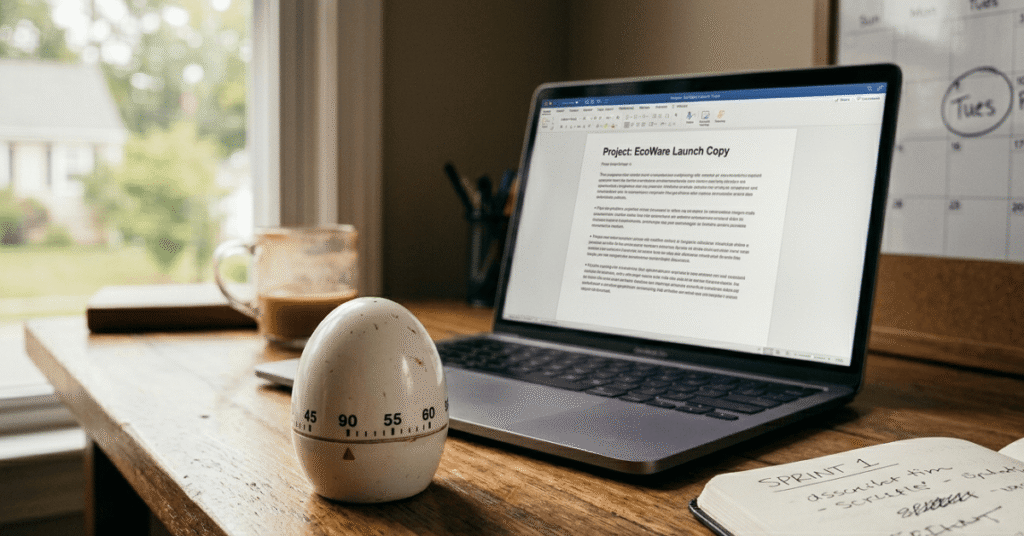
Beating the clock: Using a 90-minute kitchen timer sprint to maximize work output during nap time.
Parkinson’s Law: Work expands to fill available time. Parent version: Work contracts to fit the tiny window you actually have.
Hack #4: The "Done is Better Than Perfect" Template
What I did:
What I did: Created templates for everything I do repeatedly: Email templates:
Initial client inquiry response
Project delivered
Following up on proposal
Asking for testimonial
Project templates:
Blog post structure
Email sequence outline
Social media caption format
Landing page sections
Time saved: 15-30 minutes per project by not reinventing the wheel.
Example template (email sequence):
Email 1: Problem/pain point Email 2: Introduce solution Email 3: Overcome objection Email 4: Social proof Email 5: Call to action
Instead of figuring out structure every time, I fill in the blanks. Where to store templates: Google Docs folder, Notion, or even Apple Notes.
Hack #5: The Rough Draft Night Before
What I do: Night before writing day (even if I’m exhausted):
Spend 15-20 minutes outlining tomorrow’s project
Dump all ideas into doc
Don’t worry about quality
Next morning:
Open doc
Rough structure already there
Jump straight to writing
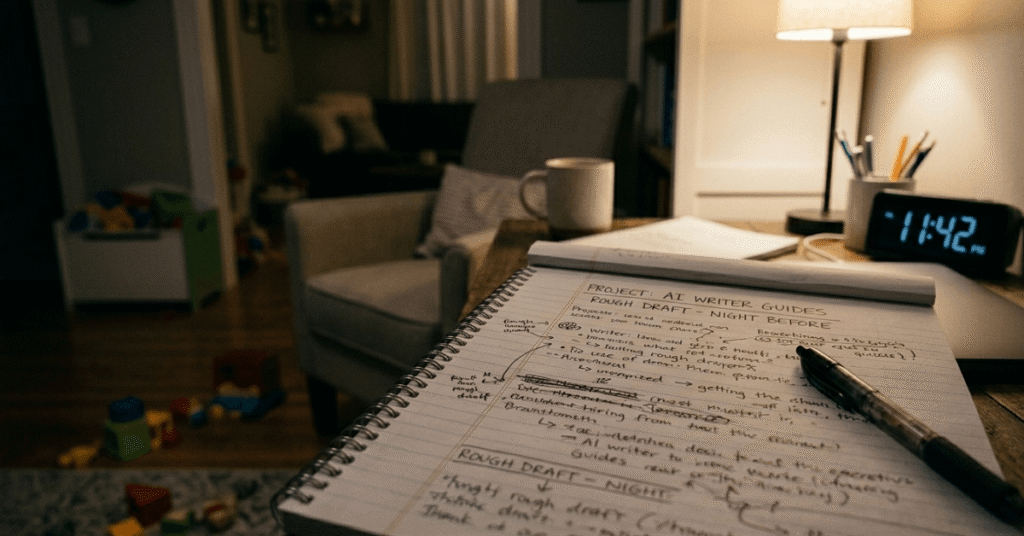
Planting seeds: A handwritten brain dump at night ensures you hit the ground running tomorrow morning.
Time saved: 20 minutes not staring at blank page trying to remember “what was I writing about?” Works even if outline is messy. Something beats nothing.
Hack #6: Batch Similar Tasks
Instead of: Writing Monday, admin Tuesday, research Wednesday Do this: All writing together, all admin together, all research together. Why: Switching between task types kills productivity. Your brain needs warm-up time. My batching schedule: Mondays & Wednesdays: Writing only
Turn off email
Close Slack
Just write
Tuesdays: Admin day
All emails
All invoicing
All scheduling
All client communication
Thursdays: Research & planning
Next week’s projects
Competitor research
Content planning
Fridays: Editing & delivery
Polish everything
Send to clients
Wrap up week
Result: Each day has ONE mode. No constant context switching.
Hack #7: The "No" Pile
What it is: A list of things you’ve decided NOT to do. My No list:
Rush projects (under 3 days)
Complex revisions after 8 PM
Client calls during naptime
Projects under $200
Free “portfolio building” work
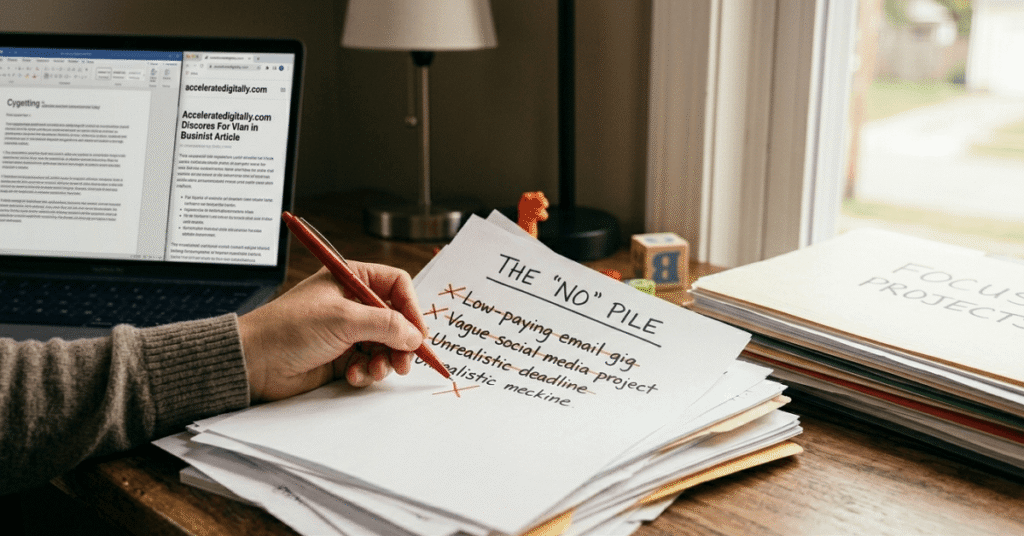
The Power of 'No': A physical stack of declined tasks clears the mental space needed for your best copywriting work.
Why this helps: Every “no” protects your limited time. And having a list means you don’t waffle when asked. Client: “Can you do this by tomorrow?” Me: Checks No list “I don’t take rush work. I can have it done in 3 days.” No guilt. No overthinking. Just: that’s on my No list.
Hack #8: The Two-Device System
What it is: One device for work. One for everything else. My setup:
Laptop: Work only (no social media, no news sites, no email apps)
Phone: Everything else (email, social media, calendar)
Why this works: When laptop is open = I’m working. No temptation to “just check Instagram.” When I want to check Instagram = I have to physically pick up phone and unlock it. That extra step is enough friction to prevent constant distraction. Can’t afford two devices? Create two user accounts on your computer. One for work. One for everything else.
Hack #9: The Pre-Write Checklist
Before I start writing, I check:
Do I know what I’m writing about
Do I have research/examples?
Do I know the goal/CTA?
Do I have at least 60 uninterrupted minutes?
If any answer is no, I don’t start writing. Instead, I:
Research if I need info
Outline if goal is unclear
Do admin tasks if time is uncertain
Why: Starting without these = wasted time and frustration. Time saved: Not starting projects I can’t finish in available time.
Hack #10: The "Future Me" Note System
When I have to stop mid-project (kid wakes up, school pickup, etc.): I leave a note for Future Me: Stopped at: conclusion section Next: Write 2-3 sentence wrap-up Remember: Client wants focus on ROI
Next time I sit down:
Read note
Pick up exactly where I stopped
No “wait, what was I doing?” time
Time saved: 5-10 minutes per session not trying to remember context.
The Hacks That DON'T Work for Parents
Skip these: ❌ “Wake up at 4 AM” → Sustainable for nobody with a baby ❌ “Block out 4-hour focus sessions” → Doesn’t exist in parent life ❌ “Eliminate all distractions” → Kids are not eliminatable ❌ “Single-task only“ → Laundry doesn’t do itself
❌ “Meditate for 1 hour daily” → When? Parent productivity is about working WITH chaos, not eliminating it.
Key Takeaways: Parent Copywriter Productivity
✅ Use timers for limited time windows – work expands to fill time available ✅ Start mid-project with AI outlines – blank pages waste mental energy ✅ Batch similar tasks together – context switching kills productivity ✅ Protect your power hour – one interruption-free hour daily ✅ Create a No list – every no protects your limited time ✅ Good enough beats perfect – clients need good work on time ✅ Leave notes for Future You – saves 5-10 minutes per session ✅ Use AI for boring stuff – works while you sleep Bottom line: Productivity when parenting isn’t about doing more. It’s about doing the right things in the time you actually have.