Problem: “You’re managing 5 projects across 3 different tools. Slack for communication. Asana for tasks. Google Drive for files.”
Agitate: “Every morning, you spend 20 minutes just figuring out what’s due today. Did Debra finish that report? Where did Mike put that file? You’re wasting an hour daily switching between apps.”
Solution: “ProjectHub puts everything in one place. Tasks, files, communication all in one dashboard. See what’s due, who’s working on what, and where every file lives. Without opening 6 tabs.”
Why this works:
People buy solutions to problems. PAS makes the problem real before offering the solution.
My experience:
First time I used PAS, I wrote an email for a productivity app. Conversions went up 12% compared to their previous email that just listed features.
The difference? I made them FEEL the frustration before solving it.
Formula #2: AIDA (Attention-Interest-Desire-Action)
What it is:
Attention: Grab their attention Interest: Keep them interested Desire: Make them want it Action: Tell them what to do next
When to use it:
Blog posts, social posts, ads, pretty much everything. It’s the most versatile formula.
Example (Homepage for Online Course)
Attention: “Spent $2,000 on Facebook ads and got 3 customers?”
Interest: “Most small business owners waste money on ads because they’re targeting everyone instead of their ideal customer. Your yoga studio ad is showing to 19-year-old gamers. That’s why it’s not working.”
Desire: “This course teaches you how to find your exact customer (not ‘women 25-45’), write ads they actually click, and stop bleeding money on bad targeting. Past students cut their ad costs in half while doubling sales.”
Action: “Enroll now and get lifetime access + 3 bonus templates.”
Why this works:
Takes people on a journey from “huh?” to “I want this” to “I’m buying now.”
When I use it:
Literally all the time. It’s my default structure when I’m not sure what else to use 🙂
Formula #3: Before-After-Bridge
The BAB formula guides your reader from a point of stress to a successful outcome, showing how your solution is the essential bridge that takes them there.
What it is:
Before: Show their current situation After: Show the better situation they want Bridge: Explain how to get from before to after
When to use it:
Case studies, testimonials, transformation stories, weight loss/fitness/lifestyle products.
Example (Coaching Service)
Before: “Six months ago, Sarah was working 60 hours a week, missing her kids’ bedtimes, and making $3,000 a month from her freelance business.”
After: “Today, she works 25 hours a week, has dinner with her family every night, and makes $7,000 a month.”
Bridge: “What changed? She learned to package her services, raise her rates, and say no to bad-fit clients. Our coaching program taught her exactly how to do all three.”
Why this works:
People buy transformations, not products. This formula shows the transformation clearly.
Real example my acquaintance wrote:
Used this for a business coach’s website. Included 5 before-after-bridge client stories.
Client told her: “People keep mentioning those stories in discovery calls. They want what Sarah got.”
Formula #4: FAB (Features-Advantages-Benefits)
What it is:
Features: What it is Advantages: What it does Benefits: What that means for them
When to use it:
Product descriptions, service pages, explaining anything technical.
Formula #5: The 4 P's (Problem-Promise-Proof-Push)
What it is:
Problem: What’s wrong Promise: What you’ll deliver Proof: Why they should believe you Push: Why they should act now
When to use it:
Sales pages, webinar pitches, service pages, anything that needs credibility.
How to Actually Use These Formulas
Formulas are starting points, not rigid scripts. Mastering copywriting means learning how to flex the formula to fit the unique voice of your client and the needs of their audience.
Step 1: Pick the Right Formula
Quick guide:
Selling something tangible? → PAS or 4 P’s
Building general interest? → AIDA
Showing transformation? → Before-After-Bridge
Explaining features? → FAB
Not sure? → AIDA (it works for almost everything)
Step 2: Don’t Follow It Exactly
Formulas are guidelines, not rules.
You can:
Combine formulas (PAS + FAB works great)
Skip parts that don’t fit
Rearrange the order
Add your own sections
Example: I often do Problem-Agitate-Solution-Proof instead of just PAS. The proof makes it more believable.
Step 3: Fill in the Blanks
Treat each section as a question to answer:
PAS Example:
Problem: What’s frustrating them?
Agitate: Why is that bad? What’s it costing them?
Solution: How does this fix it?
Write answers to those questions. Boom!, you have copy 🙂
Common Mistakes with Formulas
Mistake 1: Making It Too Obvious
Bad: “Here’s the problem. Now I’m going to agitate it. Now here’s the solution.”
Good: Just flow naturally. The reader shouldn’t notice you’re using a formula.
Mistake 2: Using the Wrong Formula
Don’t use Before-After-Bridge for a product with no transformation story.
A stapler doesn’t have a before-after. Use FAB instead.
Mistake 3: Forgetting the Customer
Bad: “Our product has [features features features]”
Good: “You know that annoying thing where [problem]? This fixes it by [solution]”
Formulas organize structure. But you still need to understand the customer.
Practice Exercise
Pick one formula. Write something using it.
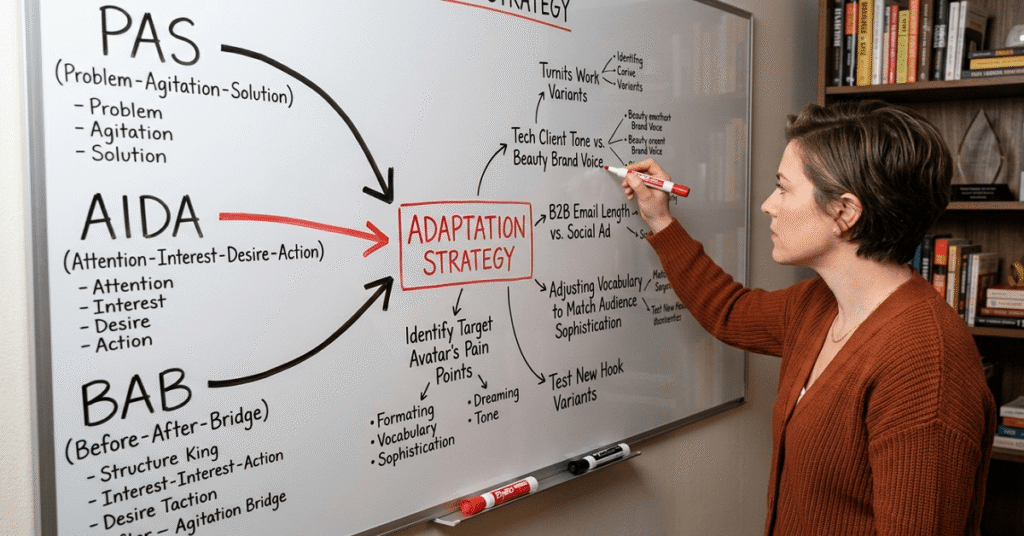
Mastering adaptation: Using strategy sessions to flex formulas for diverse industries and client needs.
Example assignment:
Write a 200-word email for a coffee shop’s new cold brew using PAS.
Problem: It’s 2 PM, you’re exhausted Agitate: Energy drinks are gross, coffee is too hot Solution: Cold brew is smooth, caffeinated, refreshing
Just fill in those blanks. And you have copy!
Key Takeaways: Copywriting Formulas
✅ PAS (Problem-Agitate-Solution) – best for sales pages and emails ✅ AIDA (Attention-Interest-Desire-Action) – works for almost everything ✅ Before-After-Bridge – perfect for transformation stories ✅ FAB (Features-Advantages-Benefits) – explains technical products ✅ 4 P’s (Problem-Promise-Proof-Push) – builds credibility ✅ Formulas are guidelines, not rules – adapt and combine them ✅ Pick the formula based on what you’re writing – not all work for everything ✅ The customer still matters most – formulas organize, but empathy sells