How to Get Your First Copywriting Client (Even With Zero Experience)
Landing your first copywriting client is scary. You’re probably thinking: “Who’s going to hire me? I don’t have samples. I don’t have testimonials. I barely know what I’m doing.”
I get it. I was there too. My first pitch email sat in my drafts folder for a week because I was terrified to send it. When I finally did, I expected nothing. Instead, I got a response next day and my first paid project by the end of the week.
Proactive networking in local communities is a powerful, direct way to present your portfolio and secure your very first clients, demonstrating immediate value even without a deep resume.
That client paid me around $100 for website copy. Not a fortune, but it proved something important: people will hire beginners if you approach them the right way.
This guide will show you exactly how to get copywriting clients when you’re just starting out: where to find them, what to say, how to handle the “I have no experience” problem, and how to actually close the deal.
Before You Start: Do You Really Need a Portfolio?
Short answer: Not as much as you think.
Here’s the truth: most beginners waste months building the “perfect” portfolio before pitching anyone. Meanwhile, people who just started reaching out are landing clients.
What You Actually Need
Minimum to start pitching:
1-2 writing samples (doesn’t have to be paid work)
A way to show those samples (Google Doc links work fine)
Confidence to say “I can help you”
That’s it.
You don’t need:
❌ A fancy website ❌ 8 portfolio pieces ❌ Years of experience ❌ Testimonials
Illustrating how to build a portfolio of spec work and strategy samples.
Creating Quick Samples (If You Have Zero)
Option 1: Rewrite something that exists
Find a bad website. Rewrite their homepage or About page. Save it as “Sample: Homepage Copy for [Industry].”
I did this with a local restaurant terrible website. Rewrote their homepage in 2 hours. Used it as a sample. Nobody ever asked if it was real client work.
Option 2: Write for a friend’s business
Someone you know has a business or side project. Offer to write something for them. Even if it’s free, you get a real sample and maybe a testimonial.
Option 3: Create spec work for a dream client
Pick a company you’d love to work with. Write a blog post they could publish. Or write an email sequence for their product. Label it clearly: “Spec work for [Company].”
The key: Make it good. Doesn’t matter if it’s real client work. If the writing is solid, it works as a sample.
The 5 Best Places to Find Your First Copywriting Client
Let’s get practical. Here’s where to actually find people who’ll pay you.
1. Upwork (Easiest Start)
Cold pitch email template:Subject: Quick question about [Business Name]Hi [Owner’s Name],I came across [Business Name] while searching for [service type] in [town]. Your [specific compliment about their business] really stood out—but I noticed your website copy could use a refresh. I’m a copywriter who helps local businesses write website copy that actually brings in customers.Would you be interested in a quick call to discuss updating your [About page/Services page]?I’ve attached a writing sample so you can see my work.Thanks![Your Name]
2. Cold Outreach to Local Businesses (My Favorite)
Why it works: Most small businesses have terrible websites and no idea how to fix them. You can actually help.
How to find them:
Google “[your town] [type of business]” (Example: “Austin plumbers” or “Denver yoga studios”)
Look at their websites
If the copy is bad or outdated, they might need help
What makes copy “bad”:
Written in 2015 and hasn’t been updated
Full of jargon and complicated words
No clear call-to-action
Just boring or confusing
Cold pitch email template:
Subject: Quick question about [Business Name]

Hi [Owner's Name],

I came across [Business Name] while searching for [service type] in [town].

Your [specific compliment about their business] really stood out—but I noticed your website copy could use a refresh. I'm a copywriter who helps local businesses write website copy that actually brings in customers.

Would you be interested in a quick call to discuss updating your [About page/Services page]?

I've attached a writing sample so you can see my work.

Thanks!
[Your Name]
Pro tip:
Actually compliment something real. Don’t be fake. If you can’t find anything to compliment, pick a different business.
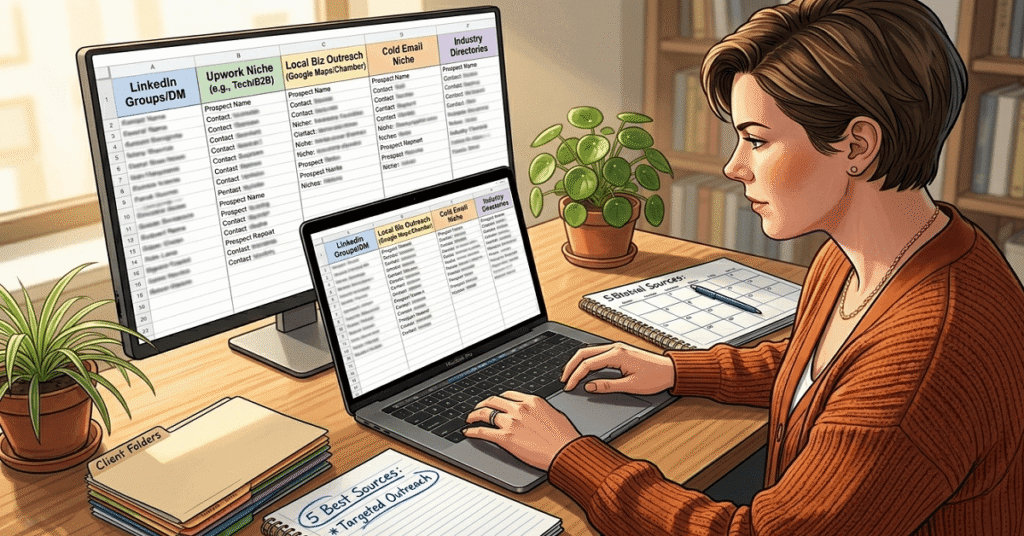
Systematic digital research and outreach organization are crucial for a copywriter’s first client hunt: here, a focused copywriter targets specific niche opportunities, structured by an outreach grid to maximize results.
3. Facebook Groups for Business Owners
Why it works: Business owners hang out in industry-specific groups. They ask for help. You can answer.
How to use it:
Join 3-5 Facebook groups related to your target clients (Examples: “Small Business Owners,” “Etsy Shop Owners,” “Real Estate Agents”)
Watch for posts where people need help with writing
Comment offering help (don’t spam)
DM them after to discuss working together
What to look for:
“Does anyone know a good copywriter?”
“I hate writing my website copy, help!”
“How do I write better product descriptions?”
My experience: Found my second client this way. She posted “I need help writing my About page, anyone know someone?” I commented. We worked together for 6 months.
Pro tip: Be helpful in the group first. Answer questions. Share useful tips. Then when you pitch your services, people already know you’re legit.
4. LinkedIn Networking
Why it works: Business owners are on LinkedIn looking for service providers.
How to use it:
Optimize your LinkedIn headline: “Copywriter | Helping [target clients] with [specific thing]”
Connect with potential clients (business owners, marketers, etc.)
Engage with their posts (comment, share)
DM after a few interactions
DM template:
Hi [Name],
I’ve been following your posts about [topic]—really enjoyed your take on [specific thing].
I’m a copywriter who helps [type of business] with [specific service]. I noticed you mentioned [pain point] in your recent post. I’d love to help if you’re looking for support with that.
Would you be open to a quick chat?
Best, [Your Name]
Pro tip: Don’t lead with “hire me.” Start with genuine connection. Help first, pitch second.
Writing Proposals That Get You Hired
Once someone’s interested, you need a proposal. Keep it simple.
Basic Proposal Structure
1. What they need (2-3 sentences)
“You mentioned you need a homepage rewrite that better explains what [Business] does and why customers should choose you.”
2. What you’ll deliver (bullet list)
New homepage copy (approximately 400 words)
3 headline options to choose from
2 rounds of revisions included
3. How it works (timeline + process)
“I’ll send you a draft within 5 business days. You review and send feedback. I’ll revise based on your notes and send the final version within 2 days.”
4. What it costs (clear pricing)
“Total investment: $300
Payment: 50% upfront ($150), 50% on completion ($150)”
5. Next steps (clear call-to-action)
“If this sounds good, just reply to this email and I’ll send over a simple agreement to sign. We can start as soon as you’re ready!”
What I Learned
Keep proposals short. Mine was one page. That’s plenty.
Don’t over-complicate it. They just want to know: What do I get? When? How much?
Red Flags to Avoid in First Clients
Not all clients are good clients. Watch out for these:
Red Flag #1: "I don't have a budget, but..."
If they can’t pay, move on. “Exposure” doesn’t pay rent.
Exception: Friends/family you’re helping to get samples. That’s different.
Red Flag #2: "I need this by tomorrow"
Unrealistic deadlines from the start mean more unrealistic demands later.
Red Flag #3: "Can you send me 5 samples first?"
Asking for a sample or two? Fine. Asking for a bunch of free work? Nope.
Red Flag #4: Scope keeps changing
“Actually, can you also write the About page? And 10 social posts? And…”
Scope creep kills your hourly rate. Say no or charge extra.
Red Flag #5: They're rude from the start
If someone’s condescending or dismissive in initial emails, they’ll be worse as a client.
Trust Your Gut
My worst client ever? I had a bad feeling from the first email. Ignored it. Regretted it.
If something feels off, it probably is. There are other clients.
Your First Week Game Plan
Visualizing actionable, structured tasks on a planning whiteboard.
Here’s exactly what to do:
Day 1-3: Get Your Samples Ready
Write 1-2 samples (use the spec work method if needed)
Put them in Google Docs
Make sure they’re easy to share
Day 4-5: Find 20 Potential Clients
10 from Upwork
10 local businesses with bad websites
Day 6-7: Send Pitches
Apply to 5-10 Upwork jobs
Send cold emails to 5-10 local businesses
Day 8: Follow Up
Join 2-3 Facebook groups
Set up a Fiverr profile
Follow up with anyone who responded
Repeat Next Week
Most people quit after week one. Don’t. Remember this is a numbers game at first.
Frequently Aked Questions
Q: How long does it take to get your first copywriting client?
A: If you actively pitch, most beginners land their first client within 2-6 weeks. Some get lucky in a few days. Others take 2-3 months. The timeline depends on how many pitches you send and how good your approach is. Consistency matters more than luck.
Q: Do I need a website to find copywriting clients as a beginner?
A: No. Most of my earlier clients came from cold emails and Upwork. A website is nice to have later, but it’s not required to start. Google Docs for samples and email for communication work fine.
Q: How much should I charge for my first copywriting client?
A: Charge enough to be taken seriously but not so much that you price yourself out. For beginners, $100-300 for small projects (homepage, About page, email sequence) is realistic. Don’t work for free unless it’s for a friend to get a sample. Use our pricing calculator to figure out fair rates.
Q: What if my first client hates my work?
A: Ask for specific feedback and revise. Most “bad” first drafts are just missing information you didn’t know to ask about. Clients usually don’t hate the work, they just want adjustments. Build in 2 revision rounds and be willing to learn from feedback.
Q: Should I work for free to build my portfolio?
A: Only for people you know personally (friends, family) to get 1-2 samples. After that, charge something: even if it’s $50. Free work attracts people who don’t value your time. Paying clients, even small ones, take you more seriously.
Q: What's the best way to find copywriting clients as a beginner?
A: Cold outreach to local small businesses (they need help and have budgets) or Upwork (lots of entry-level jobs). Both are realistic for beginners. Avoid bidding sites where you compete on price with people charging $5. Focus on quality over volume.
Q: How do I get copywriting clients with no experience?
A: Create 1-2 strong samples (spec work is fine), focus your pitch on solving their problem (not your lack of experience), and offer a low-risk trial (like one small project). Confidence matters more than years of experience. Clients hire people who can help them, not people with the longest resumes.
Q: What should I say when clients ask for my experience?
A: Don’t apologize for being new. Instead say: “I specialize in [type of writing] for [industry]. Here are samples of my work.” Shift the conversation to what you can deliver, not how long you’ve been doing it. If they push, offer to do a paid trial project at a reduced rate.