Will AI Replace Copywriters? Here's the Real Answer

If you’re a beginner copywriter, you’ve probably worried about AI taking your job. Maybe a client asked, “Why should I hire you when ChatGPT is free?” Or you saw another article predicting that AI will replace all writers by next year.

Let’s cut through the noise. This guide will give you the honest truth about AI and copywritin like what’s actually changing, what’s staying the same, and how you can build a real career even with AI everywhere.

Confident copywriter working on a project with creativity and expertise.
Copywriters will always have a unique perspective and creative flair that AI cannot replicate.

The Short Answer: No, AI Won't Replace Copywriters

Here’s what’s really happening:

AI is changing copywriting, not ending it. Think of AI like calculators and accountants. Calculators didn’t replace accountants rather they just changed what accountants do. Isn’t it? Same thing with AI and copywriters.

Some copywriting work will change. Some might disappear. But we believe the humans who understand people, strategy, and context – they aren’t going anywhere.

Let’s dig into why.

What AI Can Actually Do (The Honest Truth)

AI tools like ChatGPT, Claude, and Jasper are impressive. Let’s be real about what they’re good at:

AI is Great At:

1. First Drafts and Outlines

AI can spit out a rough draft in seconds. Need a blog post outline? Done. Want five headline options? Easy.

This is actually helpful for writers. Instead of staring at a blank page, you start with something to improve.

2. Handling Repetitive Stuff

Product descriptions that follow the same format? Social media captions that need slight variations? AI crushes this.

If you’re writing the same type of thing over and over with minor changes, AI can speed that up.

3. Research and Summaries

AI can scan tons of information and give you a summary. It’s like having an assistant who reads everything and gives you the highlights.

4. Grammar and Basic Editing

AI catches typos, fixes grammar, and suggests clearer wording. It’s like having Grammarly on steroids.

5. Generating Ideas

Stuck on what to write? AI can brainstorm topics, angles, and approaches. It’s a decent idea-generation buddy.

A creative copywriter collaborates with an advanced AI interface on a tablet.
Human creativity meets technological precision: copywriters work alongside AI to enhance their creative process.

Here's What AI Does Well:

  • Speed (writes fast)
  • Volume (can produce a lot)
  • Following patterns (copies formats it’s seen before)
  • Basic information (knows facts from its training data)

Sounds scary, right? But here’s the thing: none of this is actual copywriting yet.

What AI Can't Do (And Probably Won't Anytime Soon)

Here’s where AI falls apart and where you stay valuable:

AI Struggles With:

1. Understanding Real People

AI doesn’t know your client’s specific customers. It doesn’t know that the target audience hates corporate jargon, or that they’re tired of being talked down to, or that they value authenticity over polish.

You can talk to real people. AI can’t.

2. Strategic Thinking

AI doesn’t know why something should be written. It doesn’t understand business goals, brand positioning, or what problem the copy needs to solve.

You ask: “What’s the goal here?” AI just asks: “What words do you want?”

3. Capturing Brand Voice

Every brand sounds different. Some are funny. Some are serious. Some are rebellious. Some are warm and friendly.

AI can mimic a voice if you give it tons of examples, but it doesn’t understand the voice. It’s copying, not creating.

4. Knowing What to Leave Out

Good copywriting isn’t just about what you say it’s about what you don’t say. AI tends to over-explain and ramble because it doesn’t know when to stop.

You know when enough is enough. AI doesn’t.

5. Reading Between the Lines

When a client says “make it more engaging,” you know they probably mean “shorter sentences and more personality.” AI takes it literally and might just add exclamation points.

You understand subtext. AI doesn’t.

6. Adapting on the Fly

Halfway through a project, the client’s priorities change. You adjust. AI needs to be retrained or given entirely new instructions.

7. Building Client Relationships

Clients hire writers they trust. They want someone who asks questions, understands their business, and makes their life easier. AI is a tool. You’re a partner.

How to Stay Relevant as AI Gets Better

AI will keep improving. Here’s how you stay ahead:

1. Learn to Use AI (But Don't Depend on It)

Think of AI as your assistant, not your replacement.

Good use: “AI, give me 10 headline options for a landing page about budget software.”
Bad use: “AI, write my entire sales page” (then copying and pasting it).

Use AI to speed up your process, not skip your thinking.

2. Focus on Strategy, Not Just Writing

Anyone can write words. Not everyone can figure out what to write and why. Isn’t it?

Ask clients:

  • What’s the business goal?
  • Who’s the audience?
  • What makes you different from competitors?
  • What do you want people to do after reading this?

Then use those answers to guide your writing. AI can’t do this part.

3. Specialize in Industries or Formats

The more you know about a specific industry (like healthcare, finance, or SaaS), the more valuable you are.

AI is a generalist. You can become a specialist.

4. Build Your Personal Brand

Clients hire people they know and trust. Build relationships, share your process, show your personality.

AI is faceless. You’re not.

Working WITH AI (Not Against It)

Here’s the smart approach: use AI to handle the boring stuff so you can focus on the important stuff.

Practical Ways to Use AI in Your Workflow:

Research and Outlining:

  • Ask AI to summarize competitor websites
  • Generate blog post outlines
  • Create lists of keywords or topics

First Drafts:

  • Let AI create a rough draft
  • Then rewrite it in your voice with real insights

Brainstorming:

  • Use AI to generate 20 headline ideas
  • Pick the best 3 and improve them

Editing:

  • Run your draft through AI for grammar and clarity
  • But make the final decisions yourself

Repetitive Tasks:

  • Use AI for product descriptions that follow a template
  • Let it create social media variations
  • Have it reformat content for different platforms

The Key: You're in Charge

AI is the assistant. You’re the strategist, editor, and decision-maker.

Bad workflow: AI writes → You copy and paste
Good workflow: You strategize → AI drafts → You rewrite → You edit → You approve

Real Examples: Where Humans Still Win

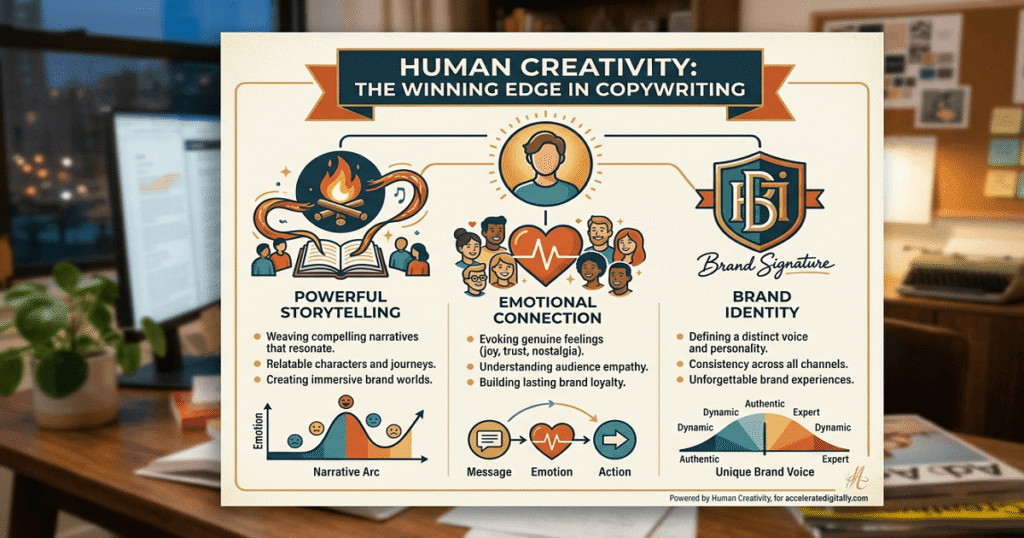
An infographic graphic demonstrating the human copywriter's unique strengths in marketing through examples of powerful storytelling, creating deep emotional connections, and establishing distinctive brand identities.
Human creativity remains the ultimate tool for crafting narratives that resonate emotionally and build unforgettable brand identities.

Let’s look at actual scenarios:

Scenario 1: Sales Page for a New Product

AI approach:

  • Generic benefits list
  • Sounds like every other sales page
  • Doesn’t address real objections
  • No understanding of what makes this product different

Human approach:

  • Interview the founder to understand the “why” behind the product
  • Research what competitors say and find the gap
  • Write to the specific pain points of the target audience
  • Include a story that makes it memorable
  • Address the objections you discovered in customer reviews

Winner: Human (by a lot)

Scenario 2: 50 Product Descriptions for an E-commerce Site

AI approach:

  • Writes all 50 in an hour
  • Follows the template perfectly
  • Consistent tone and format
  • Slightly generic but functional

Human approach:

  • Takes 2 days to write all 50
  • Adds unique personality to each one
  • Slightly inconsistent
  • More expensive

Winner: AI (for this specific task, it’s good enough and way faster)

Smart approach: AI writes the drafts, human edits for personality and accuracy.

Scenario 3: Email Sequence to Win Back Inactive Customers

AI approach:

  • Generic “we miss you” emails
  • Standard discount offers
  • No real understanding of why customers left
  • Sounds like spam

Human approach:

  • Researches why customers typically churn
  • Creates a sequence that acknowledges the gap (“We know we haven’t been in touch…”)
  • Offers real value, not just discounts
  • Feels personal and thoughtful

Winner: Human (engagement rates will be way higher)

The Future: What's Actually Coming

Let’s be realistic about where this is going:

What Will Probably Happen:

Low-value copywriting will shrink. Generic blog posts, basic product descriptions, and formulaic content will increasingly be handled by AI.

High-value copywriting will grow. Strategic work, brand building, and writing that requires real understanding of people will be more valuable than ever.

The bar will rise. Being “okay” at copywriting won’t be enough. You’ll need to be actually good.

New roles will emerge. “AI content editor” and “AI strategy consultant” are already becoming job titles.

What Probably Won't Happen:

AI won’t fully replace human copywriters. Not in 2026, probably not in 2030 either.

Clients won’t stop valuing expertise. They might use AI for some stuff, but they’ll still pay for real skill.

Copywriting won’t become obsolete. It will evolve, like every other profession when new technology arrives.

The Bottom Line

Will AI replace copywriters?

No. But it will replace copywriters who only do surface-level work.

If you’re just regurgitating information or following templates, yeah, AI can probably do that. But if you’re thinking strategically, understanding people, and creating work that actually connects? You’re valuable.


The real question isn’t “Will AI replace me?”

It’s “Am I building skills that AI can’t replicate?”

Do that, and you’ll have a career. Ignore it, and you’ll struggle.

The good news? You’re starting now, which means you can build these skills from day one. Learn to work with AI, not against it. Focus on what makes you human. And remember: clients need real people who understand real problems.

That’s you. Not a chatbot

FAQ: Quick Questions Answered

Q: Will AI replace copywriters?

A: No. AI will change some parts of copywriting and make certain low-value tasks automated, but copywriters who focus on strategy, understanding audiences, and creating work that connects with real people will remain valuable.

Q: Can copywriters compete with AI?

A: Yes, but not by trying to be faster or cheaper. Copywriters compete with AI by doing what AI can’t: understanding business strategy, knowing audiences deeply, capturing brand voice authentically, building client relationships, and making smart decisions about what to write and why.

Q: Should beginner copywriters learn to use AI tools?

A: Yes. Think of AI as an assistant that can help with research, first drafts, and repetitive tasks. But you’re still the strategist and decision maker.

Q: What copywriting skills matter most in the age of AI?

A: Strategy, audience research, interviewing clients, understanding psychology, editing with judgment, and building relationships. These are human skills that AI struggles with. Focus on thinking, not just writing.

Q: Are there copywriting jobs that AI will take over?

A: Some low-value work like basic product descriptions, repetitive social posts, and generic blog content might increasingly use AI. But strategic work like sales pages, brand building, and complex campaigns will still need humans. Focus on high-value skills.

Q: How do I explain my value to clients who want to use AI?

A: Explain that AI gives generic results that sound like everyone else. You provide strategy, brand-specific voice, audience understanding, and work that actually connects with people. AI is a tool you might use, but you’re the expert who makes decisions.

Q: Should I lower my rates because of AI?

A: No. If anything, raise them. AI makes low-quality content cheap and abundant, which makes high-quality strategic work more valuable. Don’t compete on price. Compete on quality and understanding.

Q: What's the future of copywriting with AI?

A: Copywriting will split into two paths: low-value generic work (increasingly automated) and high-value strategic work (more important than ever). Focus on the high-value path: strategy, specialization, and human skills

Related Resources