How to Work from Home as a Copywriter (Even With Kids)
Starting a freelance copywriting career from home sounds perfect, right? Set your own hours, work in pajamas, be there for your kids. No commute, no office politics, no asking permission for time off.
One of my friend who works for a SaaS client used to pitch clients with a toddler climbing on her lap :-). It works, but you need a plan.
And yeah, it really can be that good. But let’s be honest it’s messy also. Kids interrupt Zoom calls. You’re writing sales pages at 10 PM. Clients email on weekends. The kitchen table is your office and your dining room and your kids’ art studio.
This guide will show you exactly how to set up as a work from home copywriter: the workspace, the schedule, the tools so you can actually make this work without losing your mind.
Setting Up Your Workspace (Without Spending a Fortune)
You don’t need a fancy home office. But you do need somewhere that’s yours, even if it’s just a corner.
The Absolute Basics
A table or desk – Doesn’t have to be huge. I started at the kitchen table, then moved to a cheap IKEA desk in the corner of my bedroom. You just need room for a laptop and maybe a notebook.
A decent chair – This matters more than you think. You’ll be sitting for hours. Your back will thank you for getting something with support. Check Facebook Marketplace or thrift stores, you can find good office chairs for $20-50.
Good lighting – Natural light is best, but a decent desk lamp works too. You’ll get headaches trying to write in dim light.
Somewhere to put your stuff – A shelf, a drawer, a basket. You need a place to keep your work stuff separate so you’re not hunting for your notebook under your kid’s homework every morning.
Creating a focused workspace doesn't require a huge investment; smart organization and repurposing are key to budget-friendly productivity.
What I Learned the Hard Way
Working from the couch feels cozy for about 20 minutes. Then your neck hurts and you can’t focus. Have an actual workspace, even if it’s tiny.
Nice-to-Haves (But Not Required)
Monitor or laptop stand – Helps with neck strain if you’re at the computer a lot
Noise-canceling headphones – Game-changer when kids are home
A door you can close – Not always possible, but magical when you need to take a client call
Plants or something nice to look at – Sounds silly, but it helps when you’re staring at the same corner all day
Budget Options
Total startup cost: $50-150
Kitchen/dining table: Free (you already have it)
Used desk: $20-50 (Facebook Marketplace, thrift stores)
Used office chair: $20-40
Desk lamp: $10-20
Storage bin/basket: $5-10
You can upgrade later. Start simple.
Managing Time When You Have Kids at Home
This is the hardest part. Let’s talk about what actually works.
The Reality Check
If you have young kids at home, you probably can’t work a solid 8-hour day. And that’s okay. You work in chunks.
1:00-3:00 PM: Naptime work (when kids were little)
3:00-5:00 PM: Family time
8:00-10:00 PM: Work if I had a deadline
Total work time: 4-6 hours per day
That’s it. And some days were less. And that was enough to build a business.
Finding Your Work Windows
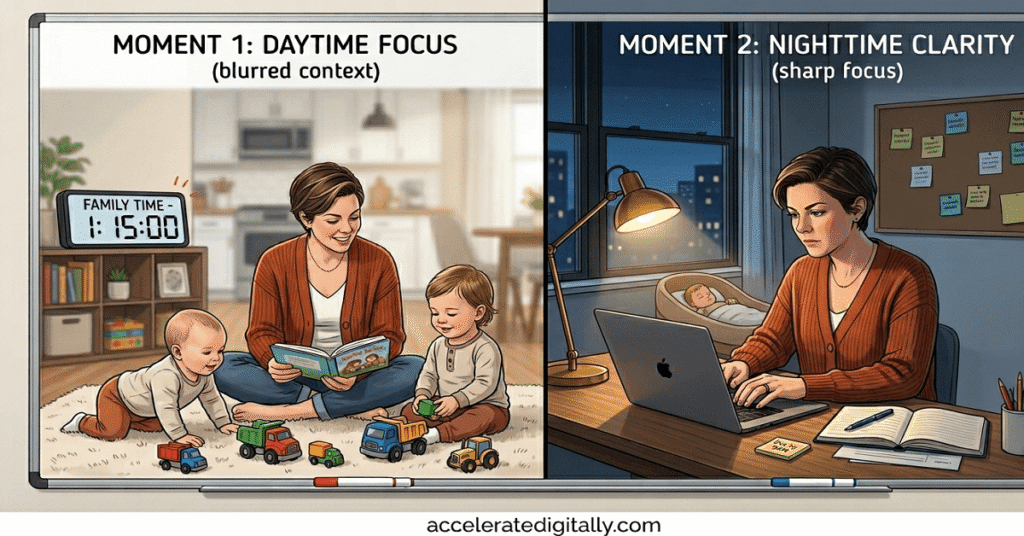
Effective time management with children isn't linear: it's about structured time-blocking to be fully present for both work and family.
Early mornings – If you can drag yourself out of bed before the kids, this is golden quiet time. I’m not a morning person, but 6 AM writing sessions built my portfolio.
Naptime – When kids are little, this is your sacred work time. Protect it. Don’t fold laundry during nap. Work.
After bedtime – Not ideal because you’re tired, but sometimes it’s the only option. I’ve written some of my best work at 9 PM and no interruptions.
Weekends – If you have a partner, trade off. Saturday morning is their time with kids, you work. Sunday morning flip it.
The "Good Enough" Schedule
You don’t need a perfect routine. You need a workable routine.
Write down:
When can you realistically work? (Be honest)
How many hours is that per week?
Can you fit client work into those hours?
If you’ve got 15-20 hours a week, you can build a copywriting business. It’ll be slower than someone working 40 hours, but it’s doable.
What Doesn't Work
❌ Trying to work while actively watching kids – They will interrupt every 3 minutes ❌ Saying “I’ll work whenever I have time” – You won’t ❌ Taking on projects that need 30 hours when you have 15 – You’ll burn out ❌ Feeling guilty about working during “family time” – Let it go
Tools You Actually Need (Most Are Free)
You don’t need expensive software to start.
Writing & Editing
Google Docs – Free, works everywhere, easy to share with clients Grammarly – Free version catches most errors Hemingway Editor – Free, makes your writing clearer
That’s it. You can upgrade later, but these three are enough.
Project Management
Notion – Free, great for tracking projects and client info Trello – Free, simple project boards Google Calendar – Free, schedule deadlines and calls
Pick one and stick with it. Don’t overcomplicate.
Invoicing & Payments
Wave – Free invoicing PayPal – Most clients already have it Stripe – Professional, easy to set up
Start with Wave for invoices and PayPal for payments. Easy and free.
My Actual Setup (What I Use)
Google Docs (writing)
Grammarly (editing)
Notion (tracking projects and client notes)
Gmail (email)
Zoom (client calls)
Wave (invoices)
PayPal (payments)
Total monthly cost: $0
I pay for Grammarly Premium now ($12/month) because it’s helpful, but the free version worked fine for the first year.
Finding Your First Clients from Home
You don’t need to leave your house to find clients. Here’s how:
Online Platforms (Easy Start)
Upwork – Lots of jobs, competitive, good for building your portfolio Fiverr – Create packages, clients come to you Contently – Higher-quality clients, harder to get accepted
Reality check: You’ll earn less on these platforms at first. But they’re good for getting experience and samples.
Cold Outreach (My Favorite)
Find businesses that need help and email them.
How to find them:
Google “[your town] small businesses”
Look at their websites
If the writing is bad or outdated, they might need you
What to say:
Subject: Quick question about [their business]
Hi [Name],
I came across [Business Name] and loved [specific thing].
I’m a freelance copywriter who helps small businesses write website copy that actually brings in customers. I noticed your [About page/Services page] could use a refresh. Would you be interested in chatting about it?
I’ve attached a couple samples of my work.
Thanks! [Your name]
Send 5-10 of these a week. You’ll get responses.
Networking (From Your Couch)
Facebook groups – Join groups for small business owners or your target industry LinkedIn – Connect with people, comment on posts, share your work Twitter/X – Follow potential clients, engage with their content
The key: be helpful. Don’t spam “hire me!” Remember to actually add value.
Referrals (The Best Source)
After you do good work for a few clients, ask: “Do you know anyone else who might need copywriting help?”
Most of my clients now come from referrals. It takes time to build, but it’s worth it.
What Worked for Me
I started on Upwork, did 5-6 projects at low rates to get samples and reviews, then switched to cold outreach and referrals. Within 9 months, I wasn’t using Upwork anymore.
Balancing Parenting and Deadlines
Let’s talk about the chaos.
When Kids Get Sick
They will. Right when you have a deadline.
Have a backup plan:
Can your partner take a sick day?
Can a family member help for a few hours?
Can you pay for a babysitter for one afternoon?
Tell clients upfront: “I have young kids. If there’s an emergency, I’ll let you know immediately and we’ll adjust the timeline.”
Most clients are understanding. The ones who aren’t? They’ve clearly never had kids.
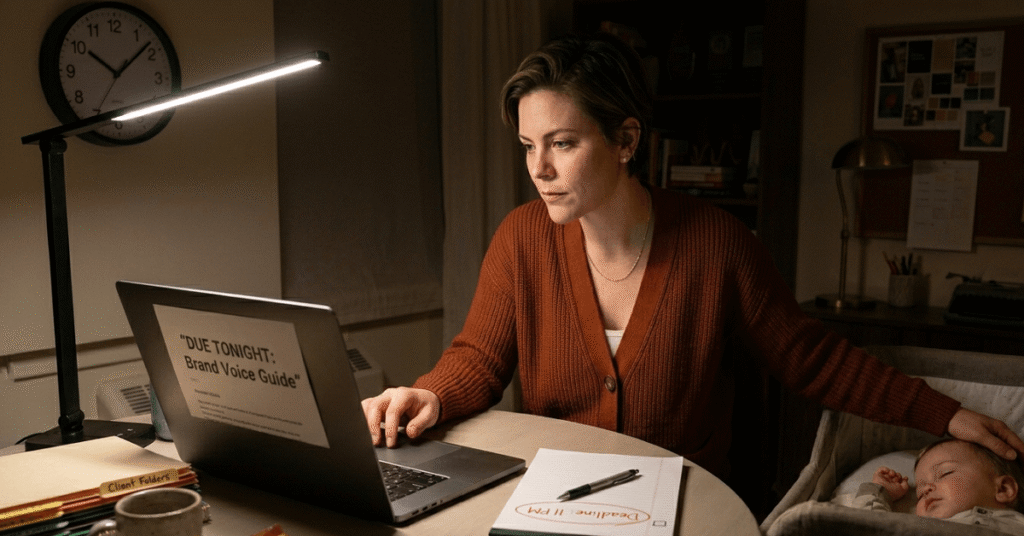
Mastering the work-from-home balance requires structured prioritization and the ability to focus intensely when deadlines loom.
When You Have a Deadline and No Childcare
Option 1: Wake up early. Like, 5 AM early. Get 2-3 hours in before chaos starts.
Option 2: Work during screen time. I’m not proud of it, but sometimes my kid watched more TV than usual so I could finish a project.
Option 3: Ask for an extension. Seriously. Most clients will give you an extra day or two.
Option 4: Hire a babysitter for a few hours. If the project pays $500, spending $40 on childcare is worth it.
What a Real Day Looks Like
Here’s what a typical day looked like for my friend, who is a mother of 3 and working as a science-fiction copywriter when she started:
6:00 AM – Wake up, make coffee, open laptop. Write for 90 minutes before kids wake up.
7:30 AM – Kid chaos. Breakfast, getting dressed, brushing teeth, finding shoes, etc.
9:00 AM – Kids at school. Back to work. Respond to emails, work on current project.
12:00 PM – Lunch. Actually stop working and eat.
1:00 PM – More work. Try to finish the current project or get close.
3:00 PM – Kids home. Work is done for now. Snack, homework, play.
5:00 PM – Make dinner (or order pizza because she’s tired).
7:00 PM – Bedtime routine for kids.
8:00 PM – Sometimes she (and me too) work another hour or two if there’s a deadline. Sometimes I watch TV. Depends on the week.
Total work time: 5-6 hours
Some days were more. Some were less. Some days she didn’t work at all because of sick kids or field trips or just needing a break.
And that was okay.
Frequently Asked Questions
Q: Can I really be a work from home copywriter with young kids?
A: Yes. It’s harder than working without kids, but totally possible. You’ll work in shorter chunks, have less predictable hours, and need good time management. Lots of successful copywriters started this way. The key is being realistic about how much time you actually have and not overcommitting to clients.
Q: How much money can you make with freelance copywriting from home?
A: It varies a lot. Beginners might make $500-$2,000 per month in the first few months. After 6-12 months, $2,000-$5,000 per month is realistic. Experienced copywriters working part-time from home can make $5,000-$10,000+ per month. It depends on your rates, how many hours you work, and your clients.
Q: What's the hardest part about being a work from home copywriter?
A: For most people, it’s setting boundaries and managing time. Work and home life blur together. You feel guilty working when kids are home. You feel guilty not working when you have deadlines. You also miss the structure of a regular job. Creating your own schedule and sticking to it is harder than it sounds.
Q: Do you need a dedicated office space to work from home?
A: Not at first. Many work from home copywriters start at the kitchen table or a corner of their bedroom. A dedicated space is nice (helps you focus and separate work from life), but it’s not required. Start where you can. Upgrade later if needed.
Q: How do you find copywriting jobs for stay at home moms?
A: The same way any beginner finds clients: online platforms (like Upwork, Fiverr), cold outreach to local businesses, networking in Facebook groups, and referrals. Being a stay-at-home parent actually gives you an advantage and you understand the challenges of other parent business owners, which can help you connect with clients.
Q: What if I have no childcare?
A: Work during naps, early mornings, after bedtime, and weekends. Trade childcare with another parent (you watch their kids Tuesday morning, they watch yours Thursday morning). Use screen time strategically. Set realistic timelines with clients. It’s harder, but doable. Many work from home copywriters started with zero childcare.
Q: Do clients care if you work from home with kids?
A: Most don’t care at all. They care about quality work and meeting deadlines. If you communicate well and deliver good writing, they’re happy. Some clients are parents themselves and totally get it. The key is being professional. For example, if a kid screams during a Zoom call, apologize quickly and keep going. It happens.
Q: How long does it take to start making money as a remote copywriter?
A: If you hustle, you can land your first paid project within 3-4 weeks. Most beginners see their first income within 1-2 months. Building to a steady income ($2,000-3,000/month) typically takes 3-6 months. Everyone’s timeline is different based on how much time you can dedicate and how quickly you find clients.