

The 4-Step Process I Use for Every Copywriting Project
Early on, every project felt chaotic. A client would reach out, I’d say yes, and then I’d just… start writing. No plan. No process. Just hoping it would work out.
Sometimes it did. A lot of times it didn’t.
I’d misunderstand what the client wanted. After enough of those experiences, I built a simple process. Four steps. Same order every time. And honestly it changed everything.
Here’s exactly what I do from the moment a client reaches out to the moment I hit send on the final draft.
Step 1 - Understand the Project Before You Agree to It
Most beginners say yes too fast. The client describes a project, it sounds straightforward, and you quote a price before you actually understand what’s involved.
This is where a lot of problems start. Before I agree to any project (and before I quote a price) I ask a standard set of questions. I call it the discovery stage. Here’s what I want to know:About the project:
- What exactly needs to be written? (Be specific; not just “a blog post” but topic, angle, target word count)
- What is the goal of this piece? (Drive traffic? Generate leads? Educate readers?)
- Who is the target audience? (Age, background, what they care about)
- What tone should the writing have? (Professional? Casual? Authoritative?)

About the process:
- What is the deadline?
- How many rounds of revisions are included?
- Are there existing brand guidelines or a style guide to follow?
- Are there competitor examples or reference content they like?
About payment:
- What is their budget?
- How do they prefer to pay?
This feels like a lot. But most of these questions take two minutes to cover in a short email or a 15-minute call. And the answers tell you everything you need to write confidently.
If a client can’t answer basic questions about their project that’s actually useful information too :-/
Step 2 - Lock Everything Down With a Brief and a Contract
Once I understand the project, I do two things before I write a single word.
First: I write a brief.
A brief is a short document that summarizes exactly what the project is. I write it myself based on what the client told me, then send it to them for confirmation. It covers:
- The topic and angle
- The target audience
- The goal of the piece
- The tone
- The word count
- The deadline
- What’s included (drafts, revisions)
This takes maybe 10 minutes. But it has saved me from misunderstandings more times than I can count.
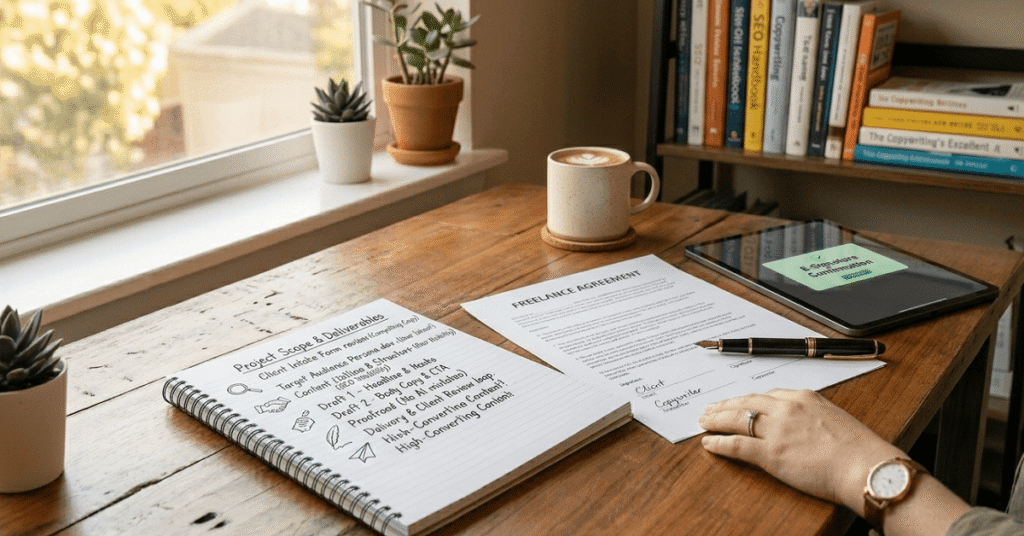
Second: I send a contract.
I know contracts feel formal when you’re just starting out. But a contract is just a written agreement. It protects both sides.
My contract covers the project description, deliverables, timeline, payment terms, revision policy, and what happens if either side needs to cancel. It doesn’t have to be long. One page is fine.
I don’t start writing until the contract is signed and the deposit is paid. This is a non-negotiable for me now. It wasn’t always and I learned that lesson the hard way.
Step 3: Write, Then Review Before You Send
Now the actual writing happens. But the way I approach the draft matters as much as the writing itself.
I write the first draft without stopping.
I don’t edit while I write. I don’t go back and fix sentences mid-paragraph. I just get the ideas down from start to finish. It’s messy. That’s fine. Getting everything out first is faster than trying to write perfectly from sentence one.
Then I wait.
If the timeline allows, I step away from the draft for at least a few hours (ideally overnight). When I come back, I read it fresh. I catch things I would have missed if I’d edited immediately after writing.
Then I review against the brief.
Before I send anything to a client, I check the draft against the original brief point by point:
- Does it match the topic and angle we agreed on?
- Does it speak to the right audience?
- Is the tone right?
- Is the word count in range?
- Does it achieve the goal?
If something doesn’t line up, I fix it before the client ever sees it. This saves revision rounds.
Finally: I run it through basic checks.
- Grammarly (free version) for grammar and spelling
- Hemingway Editor for readability: anything above grade 8 gets simplified
- One read-out-loud pass to catch awkward phrasing
Read-out-loud is underrated. My conviction is if you stumble while reading it, the client will stumble while reading it. Fix those spots.
Step 4 - Deliver Professionally and Follow Up
How you deliver work matters almost as much as the work itself.
I don’t just attach a file and hit send. I write a short note with the delivery that tells the client:
- What’s included (e.g., “Attached is the first draft of your 800-word blog post”)
- What to look for when reviewing (e.g., “I’ve flagged two spots where I’d love your input on tone”)
- What the next step is (e.g., “Please share any feedback by [date] and I’ll turn revisions around within 48 hours”)
This sounds small. But it makes you look organized and professional. It also sets expectations (the client knows exactly what happens next).
After revisions are complete and the final draft is approved:
- I send the final file in the format the client requested
- I send the final invoice if any balance is outstanding
- I save a copy of everything (the brief, contract, drafts, and final version) in a dedicated client folder on Google Drive
One week after delivery, if I haven’t heard back, I send a short follow-up. Something like: “Just checking in to make sure everything looks good on your end. Happy to answer any questions.” This is also a natural moment to ask if they have any upcoming projects.
Most of my repeat clients came from that one simple follow-up email.
The Full Process at a Glance
| Step | What Happens | Why It Matters |
|---|---|---|
| Step 1 – Understand | Ask discovery questions before agreeing | Prevents misunderstandings and bad quotes |
| Step 2 – Lock It Down | Write a brief + send a contract | Aligns expectations, protects both sides |
| Step 3 – Write & Review | Draft, wait, review against brief, run checks | Reduces revision rounds, improves quality |
| Step 4 – Deliver & Follow Up | Professional delivery + follow-up note | Builds trust, opens door for repeat work |
Frequently Asked Questions About the Copywriting Process
A copywriting brief is a short document that summarizes the project (the topic, audience, goal, tone, word count, and deadline). Writing it yourself and having the client confirm it before you start ensures you’re both aligned. It prevents the most common source of revision requests: writing something the client didn’t actually want.
Do I need a contract for every copywriting project?
Yes, even small ones. A contract clearly states what you’ll deliver, the timeline, how much you’ll be paid, how many revisions are included, and what happens if either side cancels. It protects both you and the client, and it only needs to be one page for most beginner projects.
Should I charge a deposit before starting a copywriting project?
Yes. Asking for 50% upfront before starting work is standard practice for freelance copywriters. It protects you from doing work that never gets paid for and signals to the client that you run a professional operation. Most clients who are serious about the project will have no problem with this.
How many revision rounds should a beginner copywriter include?
Two rounds is the most common standard. One round lets the client flag major issues; the second round closes the gap. Beyond two rounds, additional revisions should be billed separately. Always define what counts as a revision (refining the existing direction) versus a complete change of concept, which should be treated as a new project.
How do I get repeat clients as a freelance copywriter?
The single most effective thing is a professional, reliable process. Clients notice when you ask smart questions upfront, deliver on time, and communicate clearly throughout. A simple follow-up email one week after delivery asking if everything looks good and mentioning your availability for future projects is how most repeat relationships start.
What should I do if a client keeps asking for extra changes beyond the agreed revisions?
Refer back to your contract, which should specify the number of revisions included. Politely let the client know the agreed revisions have been used and that additional rounds are billed at your hourly rate. Having this in writing upfront makes the conversation easier.
How long does a typical copywriting project take from brief to delivery?
It depends on the length and complexity. A standard 800–1,000 word blog post typically takes 2–4 hours of actual work across research, writing, and editing. Most beginner copywriters allow 3–5 business days for delivery to give themselves time to review properly and accommodate feedback.
The Bottom Line
A good process doesn’t slow you down. It speeds you up.
When you know exactly what to do at each stage (discovery, brief and contract, writing and review, delivery and follow-up) every project runs smoother. You spend less time fixing misunderstandings. You deliver better work. And clients trust you more.
Start with this four-step framework on your next project. Mind that you don’t need to follow it perfectly right away. Even using two or three of these steps is a big improvement over winging it.
Before step one even starts make sure you know what to charge. Use the free Mille pricing calculator to get a fair rate for your next project.