

SEO Basics Every Copywriter Should Understand (Plain English Guide)
When I first heard the term “SEO copywriting,” I thought it was a completely different skill. Like something only tech people or digital marketers understood.
Turns out, it’s not that complicated. And once I got it, my writing got better and more valuable to clients.
SEO stands for Search Engine Optimization. It’s basically the practice of writing content that shows up on Google when people search for something. That’s it.
As a copywriter, you don’t need to become an SEO expert. But understanding the basics will make you a much better writer and clients will pay more for someone who gets it.
Let’s break it down simply.
Why Copywriters Need to Understand SEO

Here’s the thing, most of the content your clients need is online. Blog posts, website pages, product descriptions. All of it lives on the internet.
And if no one can find it on Google, it doesn’t matter how good the writing is.
Clients know this. When they hire a copywriter who understands SEO, they’re getting two things at once: great writing and content that actually gets found. That’s why SEO-aware copywriters can charge more.
You don’t need to run technical audits or build backlinks. Leave that to the SEO specialists. Your job is to understand the writing side of SEO and that’s very learnable.
Start Here: What Is a Keyword?
A keyword is the word or phrase someone types into Google when they’re looking for something.
For example:
- “how to write a cover letter”
- “best email marketing tools for small business”
- “copywriting rates for beginners”
When someone writes a blog post or webpage, they try to include keywords that their target audience is searching for. This tells Google what the page is about — and helps it show up in search results.
As a copywriter, your job is to include these keywords naturally in your writing. Not stuffed in every sentence. Just placed where they make sense in conversation.
The Most Important SEO Concepts for Copywriters
You don’t need to memorize every SEO term. But these core ideas will come up on almost every content project you take.
1. The Focus Keyword
This is the main keyword the client wants the page to rank for. Every piece of content has one.
The focus keyword should appear:
- In the page title or headline (H1)
- In the first 100 words of the content
- In at least one subheading (H2 or H3)
- Naturally a few more times throughout the content
That’s it. Don’t overthink it. If the keyword fits naturally, use it. If forcing it in makes the sentence awkward, don’t.
2. Headings (H1, H2, H3)
Headings aren’t just for looks. They help Google understand what your content is about.
- H1 — the main title of the page. There should only be one.
- H2 — main sections of the content.
- H3 — subsections under an H2.
Think of it like an outline. Google reads the headings to understand the structure of your article. So make your headings clear and descriptive — not clever or vague.
Bad heading: “Let’s Talk About Something Important” Good heading: “How to Set Your Copywriting Rates as a Beginner”
3. Search Intent
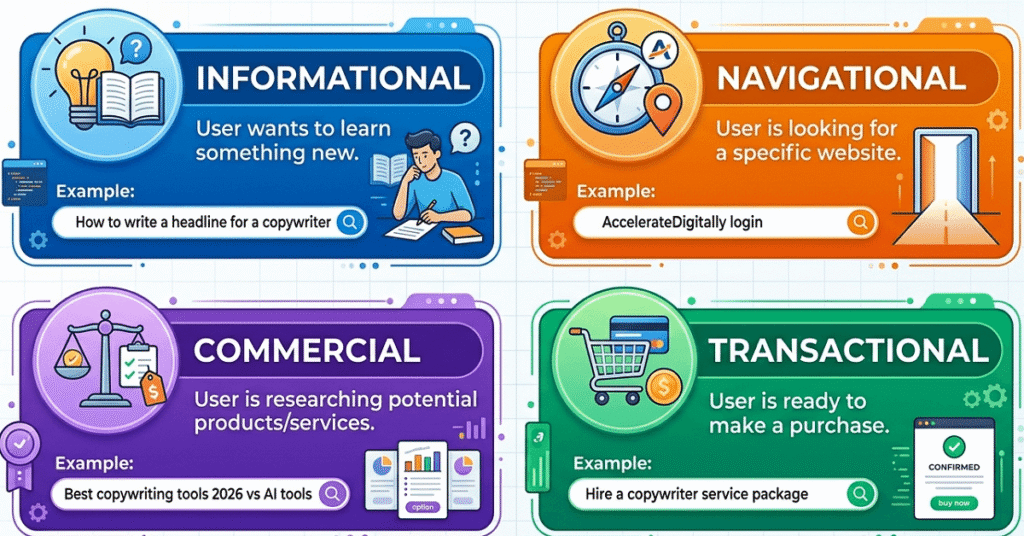
This one changed how I write. A lot.
Search intent is the reason someone is searching. Google’s job is to match the search result to what the person actually wants. So your content needs to match that intent too.
There are four main types:
Informational: they want to learn something. Example: “what is copywriting”
Navigational: they’re looking for a specific site. Example: “AccelerateDigitally pricing calculator”
Commercial: they’re comparing options before deciding. Example: “best invoicing tools for freelancers”
Transactional: they’re ready to buy or sign up. Example: “hire a freelance copywriter”
Before you write anything, ask yourself: What does this person actually want? Then write content that gives them exactly that.
4. Meta Description
The meta description is the short sentence that appears under a page title in Google search results. It doesn’t directly affect rankings, but it does affect whether someone clicks your link.
A good meta description:
- Is 150–160 characters long
- Summarizes what the page is about
- Includes the focus keyword naturally
- Gives the reader a reason to click
Most clients or SEO tools (like Yoast or Rank Math) will ask you to write this separately from the main content.
5. Internal Links
Internal links are links that point from one page on a website to another page on the same website.
They help Google understand how the site is structured. And they help readers find more useful content.
When you write a blog post, look for natural opportunities to link to other relevant pages on the same site. For example, if you’re writing about pricing and there’s a pricing calculator on the site, link to it.
Your client will appreciate this 🙂
6. Readability
Google pays attention to how easy your content is to read. Short paragraphs. Clear sentences. Logical flow. No walls of text.
This is where good copywriting and good SEO overlap completely. What’s easy for humans to read is also what Google rewards.
Tools like Yoast SEO give a readability score. Aim for content that a 6th grader could follow. That doesn’t mean dumbing things down; it means being clear and direct.
What to Avoid (Common SEO Mistakes in Copywriting)
Keyword stuffing: repeating the keyword too many times makes the writing sound unnatural and can get the page penalized by Google. Use it where it fits. That’s all.
Ignoring the search intent: writing a “how-to” article when the keyword calls for a comparison piece will hurt rankings even if the writing is great.
Vague headings: headings like “Introduction” or “More Tips” tell Google nothing. Be specific.
Too-long paragraphs: big blocks of text scare readers away. Keep paragraphs to 3-4 sentences max.
Writing for robots: some writers get so focused on SEO that the content sounds robotic. Google is actually getting better at detecting this. Write for humans first. SEO follows.
A Simple SEO Checklist for Every Piece of Content
Before you hand over any content to a client, run through this quick list:
- Focus keyword in the H1 title
- Focus keyword in the first 100 words
- Focus keyword in at least one H2 heading
- Headings are clear and descriptive (H1 → H2 → H3 structure)
- Paragraphs are short (3-4 sentences max)
- Meta description written (150-160 characters)
- At least 1-2 internal links included
- Content matches the search intent
- No keyword stuffing; reads naturally
Print this out. Use it on every content project. Your clients will notice the difference.
Do You Need to Learn SEO Tools?

Not right away. When you’re starting out, understanding the concepts is enough.
As you get more comfortable, tools like Google Search Console, Ahrefs, or Semrush can show you how pages are performing and what keywords people are searching for. Most clients who hire content writers will handle keyword research themselves and hand you the target keyword.
Your job is to take that keyword and write something genuinely useful around it. That’s where good copywriting and basic SEO meet.
Frequently Asked Questions About SEO for Copywriters
Do copywriters need to know SEO?
Yes, and it’s one of the fastest ways to become more valuable to clients. Most content lives online, and if it doesn’t show up in search results, it doesn’t matter how well it’s written. Copywriters who understand basic SEO can charge more and win better projects.
What is the difference between SEO and copywriting?
Copywriting is the craft of writing persuasive, engaging content. SEO is the practice of making that content findable on Google. The two work together: good SEO copywriting is writing that reads naturally for humans and is structured in a way search engines can understand.
What is keyword stuffing and why should copywriters avoid it?
Keyword stuffing means using a keyword so many times that the writing sounds forced and unnatural. Search engines like Google penalize pages that do this. The goal is to use keywords only where they fit naturally (just like you would in normal conversation.)
What is search intent and why does it matter?
Search intent is the reason behind a search. Someone typing “what is copywriting” wants to learn. Someone typing “hire a freelance copywriter” is ready to take action. If your content doesn’t match what the searcher actually wants, it won’t rank well even if the writing is excellent.
How many times should a keyword appear in a blog post?
There’s no magic number. A safe approach is to include the focus keyword in the title, opening paragraph, one subheading, and a few more times naturally throughout. For a 1,000-word post, that’s typically 4-6 times. What matters more than the count is whether it reads naturally.
Do beginner copywriters need to use SEO tools like Ahrefs or Semrush?
Not at first. Understanding the core concepts (keywords, headings, search intent, meta descriptions, and readability) is enough to get started. Most clients will do keyword research themselves and hand you the target keyword. SEO tools become useful later as you grow.
Does AI-generated content rank on Google?
Google’s focus is on content quality, not how it was written. Content written with AI assistance can rank well if it is accurate, helpful, genuinely useful to the reader, and written for people not search engines. What Google penalizes is low-quality, unhelpful content regardless of how it was produced.
The Bottom Line
SEO isn’t a secret skill. It’s just a set of guidelines for writing content that people can actually find.
Once you understand keywords, headings, search intent, and readability, you’re already ahead of most beginner copywriters. And that means you can offer more value to clients, charge more, and stand out in a crowded market.
Start simple. Apply the checklist above to your next piece of content. You’ll get the hang of it faster than you think.
Want to know what to charge for SEO content writing? Use the free Mille pricing calculator to find a rate that reflects the extra value you bring.